TURN THE TIDE
There are moments when things are not going your way.
You are behind.
The pressure is rising.
The clock is running.
That is exactly when you turn the tide.
Not by waiting.
Not by hoping.
Not by making excuses.
You turn it through energy, intensity, discipline, and the absolute will to win.
Be aggressive about your goals.
Be relentless in your execution.
Fall in love with making things happen — not with explaining why they didn't.
Fight until the last second.
And if necessary, beyond it.
Because as long as you are still fighting, the outcome is not decided.
Momentum can change.
A game can change.
A business can change.
A life can change.
You can achieve more than you think — if you are willing to give more than you thought possible.
Never surrender the outcome too early.
TURN THE TIDE.
*
Minuten
TURN THE TIDE
There are moments when things are not going your way.
You are behind. The pressure is rising. The clock is running.
That is exactly when you turn the tide.
Not by waiting. Not by hoping. Not by making excuses.
You turn it through energy, intensity, discipline, and the absolute will to win.
Be aggressive about your goals. Be relentless in your execution. Fall in love with making things happen — not with explaining why they didn't.
Fight until the last second. And if necessary, beyond it.
Because as long as you are still fighting, the outcome is not decided.
Momentum can change. A game can change. A business can change. A life can change.
You can achieve more than you think — if you are willing to give more than you thought possible.
Never surrender the outcome too early.
TURN THE TIDE.
May 15, 2026
2026
Ulvi AYDIN (Jahrgang 1960) ist preisgekrönter Premium Executive Interim Manager (DDIM)Unternehmens- und Unternehmer-EntwicklerBeiratXING-InsiderSpeakerMarkenbotschafterBuchautor - AYCON BücherDEUTSCHE BÖRSE GRUPU zetifizierter und qualifizierter Aufsichtsrat:devider:Als international agierender Interim-CEO und -CSO unterstützt er mittelständische Unternehmen und Konzerne bei Marken- und Marktentwicklung, Neu-Positionierung, Restrukturierung und Vertriebsexzellenz. Als international agierender Interim-CEO und -CSO unterstützt er mittelständische Unternehmen und Konzerne bei Marken- und Marktentwicklung, Neu-Positionierung, Restrukturierung und Vertriebsexzellenz. AYDIN ist … … Mitglied im IBWF - Institut & Beraternetzwerk qualifizierter Unternehmensberater, Steuerberater, Wirtschaftsprüfer, Rechtsanwälte und Notare für den Mittelstand - IBWF… Mitglied im Berufsfachverband "Die KMU Berater-Bundesverband freier Berater e.V.“. - KMU Berater… zertifizierter BAFA Berater und zertifizierter „BERATER OFFENSIVE MITTELSTAND“. - BAFA… Mitglied im DDIM - Dachgesellschaft Deutsches Interim Management e.V. - DDIM … Mitglied im ArMiD, Aufsichtsräte Mittelstand in Deutschland e.V. - ArMIDZertifizierter & Qualifizierter Aufsichtsrat - DEUTSCHE BÖRSE GROUP - DEUTSCHE BÖRSE Über seine Erfahrungen als Interim Manager schreibt er in diversen Wirtschaft-Medien (Wirtschaftswoche, SpringerProfessional, Transformations-Magazin, Controller Magazin, Harvard Business Manager, etc.).
*
Minuten
About Ulvi I. AYDIN
Ulvi I. AYDIN: Als international agierender Interim-CEO und -CSO unterstützt er mittelständische Unternehmen und Konzerne bei Marken- und Marktentwicklung, Neu-Positionierung, Organisations-Entwicklung, Restrukturierung und Vertriebsexzellenz.
Global Market Attractiveness – Beyond GDP per CapitaGDP per capita alone is not sufficient to assess the strategic attractiveness of an industrial market. A country may be extremely wealthy per capita—such as Liechtenstein or Luxembourg—but still offer limited industrial market potential because of its small size.For an industrial company such as Innomotics, I would combine four dimensions:GDP per capita + Total GDP + Degree of Industrialization + Energy Demand & GrowthStrategic AssessmentThis is a management assessment rather than a mathematically calculated index. A rigorous Market Attractiveness Index would normalize the underlying data and apply explicit weightings.1. China – The Industrial HeavyweightChina clearly belongs in Tier 1.The reason is not GDP per capita. It is the combination of an enormous economy, the world's largest industrial ecosystem, massive electricity consumption and continued infrastructure investment.China accounts for an extraordinary share of global manufacturing and industrial electricity consumption.Management message:China is not necessarily the richest market. It is the largest industrial-energy ecosystem.For motors, drives, high-voltage applications, mining, metals, chemicals, infrastructure and large industrial projects, China remains one of the most important markets in the world.2. USA – Probably the Strongest Overall CombinationThe United States combines something very few countries can offer:Very high GDP per capita × enormous market size × strong industrial base × increasing electricity demand.The additional energy demand generated by AI, data centers, semiconductor plants, reshoring, electrification and new manufacturing capacity makes the US particularly attractive.For an industrial technology company, this combination is exceptional.Management message:USA = High purchasing power × enormous scale × investment × increasing power demand.From an Innomotics perspective, North America should therefore be considered a Must-Win Market.3. India – The Major Future Growth MarketIndia demonstrates perfectly why GDP per capita can be misleading.India does not appear anywhere near the top of the GDP-per-capita ranking, yet strategically it is far more important than most countries shown there.Why?1.4+ billion people + massive economy + industrialization + urbanization + infrastructure investment + rapidly increasing electricity demand.India's electricity demand continues to grow significantly faster than that of most mature economies.Management message:Low GDP per capita does not mean low market potential. India proves exactly the opposite.India is therefore not simply an emerging market. It should be regarded as one of the world's major industrial growth markets for the next decade.4. Germany – Strong but MatureGermany remains highly relevant because of its exceptionally strong industrial base.However, the nature of the opportunity differs fundamentally from China, India or parts of the Middle East.Germany is primarily a:Replacement + Modernization + Efficiency + Decarbonization Marketrather than an explosive capacity-growth market.Retrofits, energy efficiency, automation, digitalization and replacement investments therefore become particularly important.5. Saudi Arabia and the Middle East – Increasing Strategic ImportanceSaudi Arabia deserves significantly more attention than a GDP-only analysis would suggest.It combines:Capital availability + energy + infrastructure + mining + industrialization + water + major transformation projects.Saudi Arabia's diversification strategy is creating substantial industrial investment opportunities.The UAE is much smaller, but combines high purchasing power with major infrastructure investment and an important role as a regional business hub.Three Strategic Market CategoriesTIER 1 – MUST WIN🇨🇳 China🇺🇸 USA🇮🇳 IndiaThese markets combine scale, industrial activity, investment and energy demand at an exceptional level.TIER 2 – DEFEND & GROW🇩🇪 Germany / Central Europe🇸🇦 Saudi Arabia🇦🇪 UAE🇮🇩 IndonesiaStrong industrial and/or investment markets with substantial specific growth opportunities.TIER 3 – HIGH VALUE / SELECTIVE🇸🇬 Singapore🇨🇭 Switzerland🇳🇴 NorwayVery wealthy and technologically advanced markets, but their absolute size limits their strategic leverage compared with China, the US or India.Recommended Market Attractiveness ModelFor an Innomotics-type industrial business, I would not give GDP per capita too much weight.My suggested weighting would be:15% – GDP per capita25% – Total GDP / Market Size25% – Degree of Industrialization35% – Energy Demand & Future Energy Growth:devider:The logic is simple:Don't follow wealth. Follow industrial activity, investment and energy demand.This changes the picture completely.Liechtenstein, Luxembourg and other extremely wealthy small economies disappear from the strategic top tier.China, USA and India move to the top.And for a company selling motors, drives and industrial electrification solutions, that is ultimately what matters:The most attractive market is not necessarily where people are richest. It is where industrial activity, investment and energy demand come together — at scale.
9 unbequeme Fragen. Und keine Ausreden.
Eine Psychiaterin stellte einmal neun Fragen, die auf den ersten Blick einfach wirken. Aber wenn man versucht, sie wirklich ehrlich zu beantworten, werden sie plötzlich unbequem:
1. Wenn du nur noch einen Tag zu leben hättest – wem würdest du es sagen?
2. Wenn du alles zurückbekommen könntest, was du jemals verloren hast – wonach würdest du zuerst suchen?
3. Wie alt wärst du, wenn du nicht wüsstest, wie alt du bist?
4. Wenn du jetzt überall auf der Welt sein könntest – würdest du zu einem Ort reisen oder zu einem Menschen?
5. Würdest du deine schlimmste Erinnerung löschen oder deine schönste noch einmal erleben?
6. Welches „Was wäre, wenn …?“ beschäftigt dich bis heute?
7. Wenn du für immer leben könntest – würdest du es wollen?
8. Wenn alle Menschen, denen du jemals begegnet bist, in einem Raum wären – nach wem würdest du zuerst suchen?
9. Hast du dich selbst schon einmal vermisst? Den Menschen, der du einmal warst?
Kannst du diese Fragen beantworten?
Dann beantworte sie. Aber nicht so, wie es gut klingt. Nicht so, wie andere dich gerne sehen würden. Sondern so, wie die Antwort lautet, wenn niemand außer dir zuhört.
Kannst du einige dieser Fragen nicht beantworten?
Dann ist vielleicht genau das die wichtigere Erkenntnis.
Denn wir Menschen sind erstaunlich gut darin, anderen etwas vorzumachen. Noch besser sind wir darin, uns selbst etwas vorzumachen.
Genau darum geht es in unserem Buch:
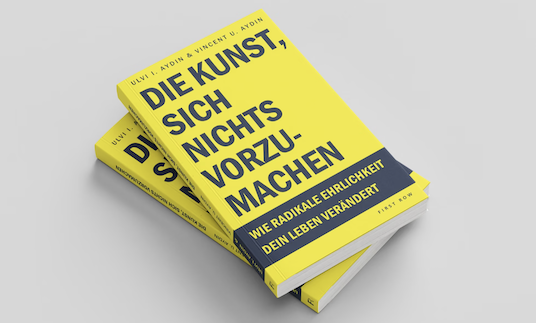
„Die Kunst, sich nichts vorzumachen – Wie radikale Ehrlichkeit dein Leben verändert.“
Nicht um Selbstoptimierung. Nicht um Wohlfühlweisheiten. Sondern um den Mut, in den Spiegel zu schauen und sich zu fragen:
Was will ich wirklich?
Was verdränge ich?
Was belüge ich mir schön?
Und was würde ich ändern, wenn ich endlich aufhörte, mir selbst Geschichten zu erzählen?
Vielleicht brauchst du dieses Buch nicht, weil du keine Antworten hast.
Vielleicht brauchst du es gerade deshalb, weil du glaubst, schon alle Antworten zu kennen.
*
Minuten
9 unbequeme Fragen.
Und keine Ausreden! Kein Bullshit! Keine Selbsttäuschung!
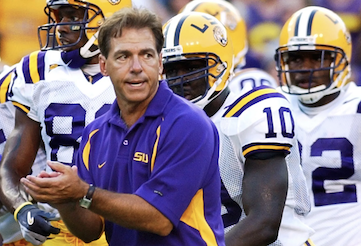
Nick Saban – A Leadership Icon I Deeply RespectNick Saban is not just one of the greatest coaches in American football history. For me, he is one of the most impressive leadership personalities of our time.
Seven national championships are not luck. They are the result of discipline, uncompromising standards, accountability, preparation, and relentless execution.That is exactly what I admire about him.Saban does not tolerate excuses. He does not manage by hope. He does not lower the standard because circumstances become difficult. His philosophy is brutally simple: Do your job. Own your responsibility. Execute. Every single day.And most importantly: Stop staring at the scoreboard.You cannot control the final result. But you can control your preparation, your actions, your intensity, and your next move.:devider:That philosophy applies to football. It applies to leadership. And it absolutely applies to sales.Win the next play. Win the next customer. Win the next opportunity. Then do it again. Relentlessly.That is why I deeply respect Nick Saban.:devided:Ulvi's 10 Leadership Principles – Inspired by Nick Saban’ - Applied to SalesTrust the ProcessDon’t obsess about the final result. Focus relentlessly on the actions that create it.Dominate Your AssignmentKnow your responsibility. Own your territory. Execute your job better than anyone else.Standards Over MotivationMotivation comes and goes. Standards remain. Perform at your standard every single day.Execution WinsStrategy gives direction. Execution delivers results. Great plans mean nothing without great execution.Never Become ComplacentYesterday’s success guarantees nothing. Yesterday’s customer does not guarantee tomorrow’s order.Measure What MattersDon’t just measure results. Measure the behaviors that create results. What gets measured gets managed.Correct Mistakes ImmediatelyLosing is information. Understand what went wrong, correct it quickly, and make sure it does not happen again.No Excuses – Take OwnershipStop blaming the market, competitors, prices, products, or customers. Ask instead: What can we do differently?Create AccountabilityEvery action needs an owner. Every owner needs a commitment. Every commitment needs a deadline and a measurable result.Win the Next PlayDon’t mourn yesterday’s loss. Don’t celebrate yesterday’s win for too long. Focus on what comes next: Win the next customer. Win the next meeting. Win the next opportunity. Win the next order. Then do it again.:devider:Don’t obsess about the scoreboard. Obsess about the next action. Execute relentlessly — and the scoreboard will follow.How big is your frying pan?
Bad - average - good - excellent or elite - your decision!
*
Minuten
How big is your frying pan?
Bad - average - good - excellent or elite - your decision!
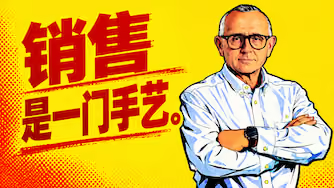
SALES IS A CRAFT. MASTER IT. Everybody talks about sales strategy. Market strategies.
Growth strategies.
Customer strategies.
Go-to-market strategies. Fine. But even the smartest strategy is worthless if the execution is poor. Sales is not only strategy. Sales is craftsmanship. And craftsmanship means doing the basics exceptionally well. Every day. Again and again. 1. SHOW UP. Go and see your customers. Not only on Teams. Not only by email. Not only when there is an RFQ on the table. Get in front of them. Show genuine interest. Understand their business. Understand their problems. Build relationships. And make one thing unmistakably clear: We want your business. Customers should feel that you are willing to work hard for the relationship. 2. PRIORITIZE YOUR CUSTOMERS. Not every customer deserves the same amount of your time. Cluster them. A. B. C. Know which customers generate your business today — and which customers could generate your business tomorrow. Define priorities. Then define the right actions for every cluster. Who needs a personal visit?
Who needs management attention?
Who needs technical support?
Who needs a call every month? Stop treating every customer the same. 3. PUT A NUMBER ON EVERY CUSTOMER. What is the potential? €500,000?
€1 million?
€5 million? Define it. Then define how much of that potential you intend to capture. Because if you don't know where you want to go, don't be surprised where you end up. Or, as the old saying goes: “No wind is favorable to the sailor who does not know which port he is heading for.” Customer potential without a target is just a number. Give every important customer a destination. 4. BE RELENTLESS. Sales requires persistence. Especially with customers who are not buying from you yet. And especially with customers you have lost to competitors. My rule is simple: Approach them ten times. Call. Visit. Follow up. Bring an idea. Bring an expert. Bring a solution. Come back. Again. Again. Again. Not because you want to annoy them. Because you want them to understand: We want you as our customer. And we are willing to fight for your business. 5. WORK. WORK. WORK. There is no sophisticated substitute for hard work in sales. Do your homework. Prepare your meetings. Know the customer. Know the decision-makers. Know the competition. Know the opportunity. Follow up. Keep your promises. Document what you agreed. Define the next step. And then execute it. That is what I mean by clean sales craftsmanship. Sales success is not created in PowerPoint. It is created through hundreds of disciplined actions in the market. Step by step.
Customer by customer.
Opportunity by opportunity. Strategy tells you where to go. Tactics get you there. And execution separates those who talk about growth from those who actually deliver it. Show up. Be prepared. Be persistent. Execute relentlessly. That is sales.
SALES IS A CRAFT. MASTER IT. Everybody talks about sales strategy. Market strategies.
Growth strategies.
Customer strategies.
Go-to-market strategies. Fine. But even the smartest strategy is worthless if the execution is poor. Sales is not only strategy. Sales is craftsmanship. And craftsmanship means doing the basics exceptionally well. Every day. Again and again. 1. SHOW UP. Go and see your customers. Not only on Teams. Not only by email. Not only when there is an RFQ on the table. Get in front of them. Show genuine interest. Understand their business. Understand their problems. Build relationships. And make one thing unmistakably clear: We want your business. Customers should feel that you are willing to work hard for the relationship. 2. PRIORITIZE YOUR CUSTOMERS. Not every customer deserves the same amount of your time. Cluster them. A. B. C. Know which customers generate your business today — and which customers could generate your business tomorrow. Define priorities. Then define the right actions for every cluster. Who needs a personal visit?
Who needs management attention?
Who needs technical support?
Who needs a call every month? Stop treating every customer the same. 3. PUT A NUMBER ON EVERY CUSTOMER. What is the potential? €500,000?
€1 million?
€5 million? Define it. Then define how much of that potential you intend to capture. Because if you don't know where you want to go, don't be surprised where you end up. Or, as the old saying goes: “No wind is favorable to the sailor who does not know which port he is heading for.” Customer potential without a target is just a number. Give every important customer a destination. 4. BE RELENTLESS. Sales requires persistence. Especially with customers who are not buying from you yet. And especially with customers you have lost to competitors. My rule is simple: Approach them ten times. Call. Visit. Follow up. Bring an idea. Bring an expert. Bring a solution. Come back. Again. Again. Again. Not because you want to annoy them. Because you want them to understand: We want you as our customer. And we are willing to fight for your business. 5. WORK. WORK. WORK. There is no sophisticated substitute for hard work in sales. Do your homework. Prepare your meetings. Know the customer. Know the decision-makers. Know the competition. Know the opportunity. Follow up. Keep your promises. Document what you agreed. Define the next step. And then execute it. That is what I mean by clean sales craftsmanship. Sales success is not created in PowerPoint. It is created through hundreds of disciplined actions in the market. Step by step.
Customer by customer.
Opportunity by opportunity. Strategy tells you where to go. Tactics get you there. And execution separates those who talk about growth from those who actually deliver it. Show up. Be prepared. Be persistent. Execute relentlessly. That is sales.
*
Minuten
Define the Potentials!
Strategy alone doesn't get you where you are supposed to be!
Wenn Sie auf "Alle Cookies akzeptieren" klicken, stimmen Sie der Speicherung von Cookies auf Ihrem Gerät zu, um die Navigation auf der Website zu verbessern, die Nutzung der Website zu analysieren und unsere Marketingmaßnahmen zu unterstützen. Weitere Informationen finden Sie in unserer Datenschutzrichtlinie.