Global Market Attractiveness


Global Market Attractiveness – Beyond GDP per Capita
GDP per capita alone is not sufficient to assess the strategic attractiveness of an industrial market.
A country may be extremely wealthy per capita—such as Liechtenstein or Luxembourg—but still offer limited industrial market potential because of its small size.
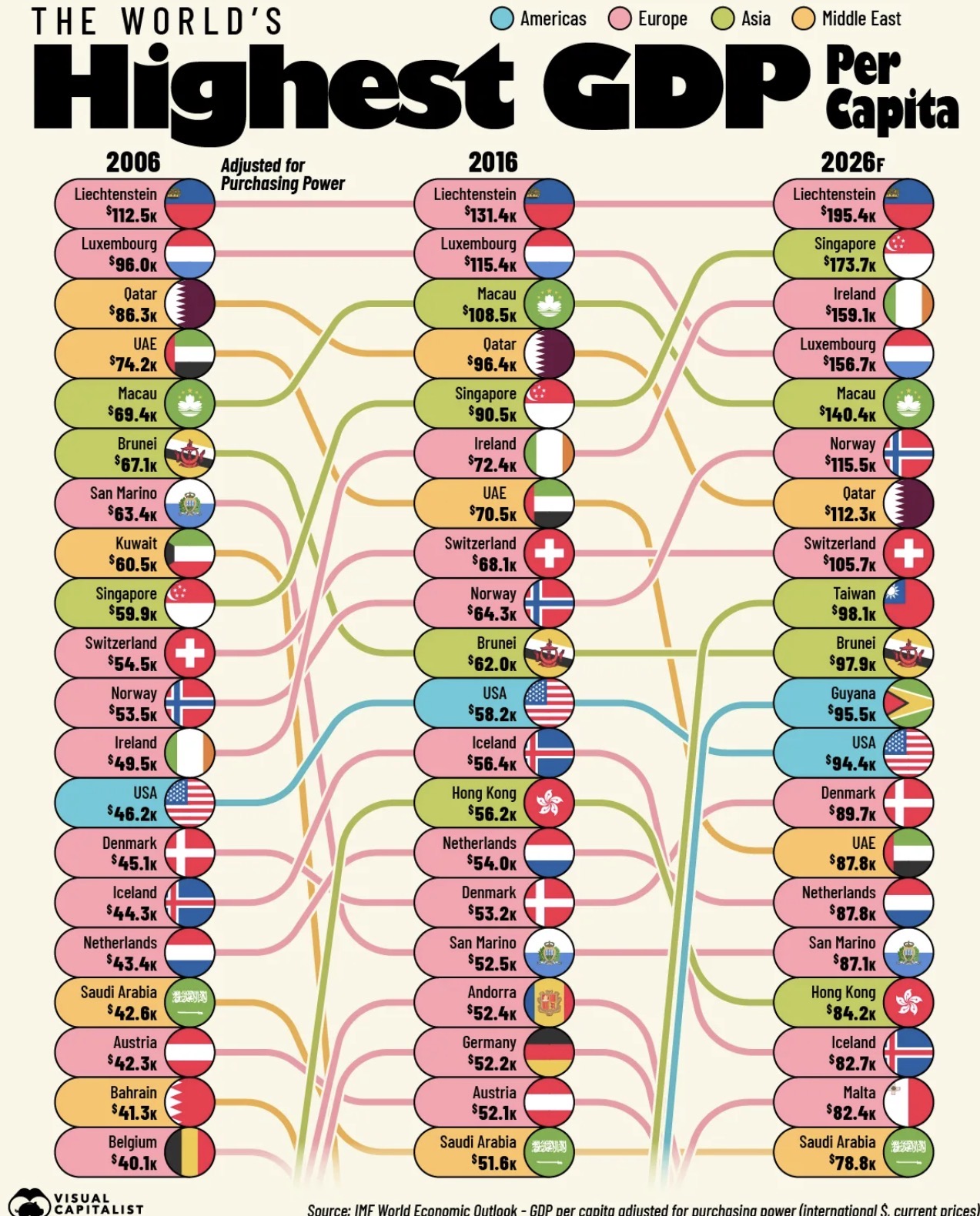
For an industrial company like ours I am combining those dimensions:
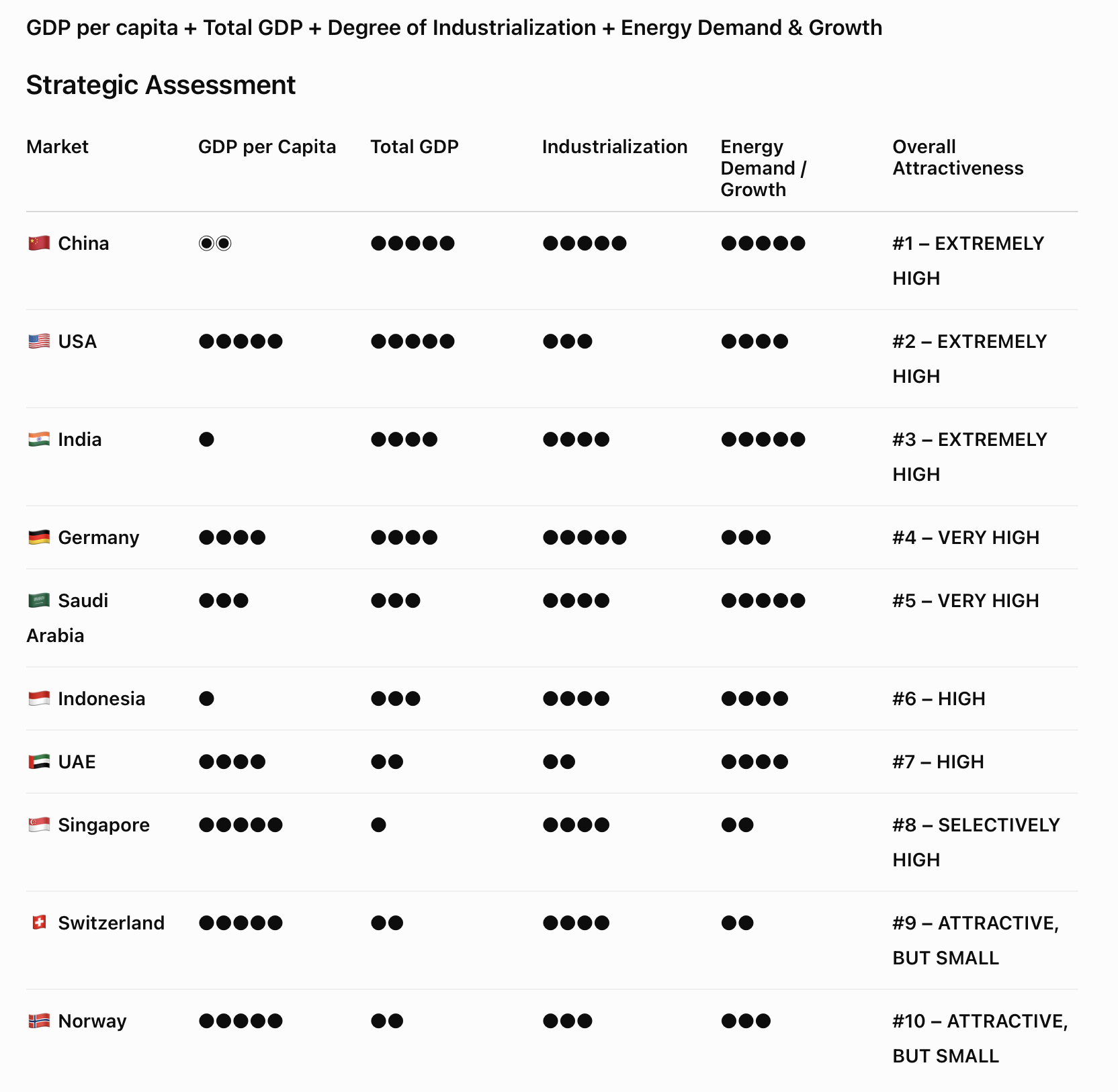
GDP per capita + Total GDP + Degree of Industrialization + Energy Demand & Growth
:devider:
Strategic Assessment
This is a management assessment rather than a mathematically calculated index.
A rigorous Market Attractiveness Index would normalize the underlying data and apply explicit weightings.
1. China – The Industrial Heavyweight
China clearly belongs in Tier 1.
The reason is not GDP per capita. It is the combination of an enormous economy, the world's largest industrial ecosystem, massive electricity consumption and continued infrastructure investment.
China accounts for an extraordinary share of global manufacturing and industrial electricity consumption.
Management message:
China is not necessarily the richest market. It is the largest industrial-energy ecosystem.
For motors, drives, high-voltage applications, mining, metals, chemicals, infrastructure and large industrial projects, China remains one of the most important markets in the world.
2. USA – Probably the Strongest Overall Combination
The United States combines something very few countries can offer:
Very high GDP per capita × enormous market size × strong industrial base × increasing electricity demand.
The additional energy demand generated by AI, data centers, semiconductor plants, reshoring, electrification and new manufacturing capacity makes the US particularly attractive.
For an industrial technology company, this combination is exceptional.
Management message:
USA = High purchasing power × enormous scale × investment × increasing power demand.
From an Innomotics perspective, North America should therefore be considered a Must-Win Market.
3. India – The Major Future Growth Market
India demonstrates perfectly why GDP per capita can be misleading.
India does not appear anywhere near the top of the GDP-per-capita ranking, yet strategically it is far more important than most countries shown there.
Why?
1.4+ billion people + massive economy + industrialization + urbanization + infrastructure investment + rapidly increasing electricity demand.
India's electricity demand continues to grow significantly faster than that of most mature economies.
Management message:
Low GDP per capita does not mean low market potential. India proves exactly the opposite.
India is therefore not simply an emerging market. It should be regarded as one of the world's major industrial growth markets for the next decade.
4. Germany – Strong but Mature
Germany remains highly relevant because of its exceptionally strong industrial base.
However, the nature of the opportunity differs fundamentally from China, India or parts of the Middle East.
Germany is primarily a:
Replacement + Modernization + Efficiency + Decarbonization Market
rather than an explosive capacity-growth market.
Retrofits, energy efficiency, automation, digitalization and replacement investments therefore become particularly important.
5. Saudi Arabia and the Middle East – Increasing Strategic Importance
Saudi Arabia deserves significantly more attention than a GDP-only analysis would suggest.
It combines:
Capital availability + energy + infrastructure + mining + industrialization + water + major transformation projects.
Saudi Arabia's diversification strategy is creating substantial industrial investment opportunities.
The UAE is much smaller, but combines high purchasing power with major infrastructure investment and an important role as a regional business hub.
:devider:
Three Strategic Market Categories
TIER 1 – MUST WIN
🇨🇳 China
🇺🇸 USA
🇮🇳 India
These markets combine scale, industrial activity, investment and energy demand at an exceptional level.
TIER 2 – DEFEND & GROW
🇩🇪 Germany / Central Europe
🇸🇦 Saudi Arabia
🇦🇪 UAE
🇮🇩 Indonesia
Strong industrial and/or investment markets with substantial specific growth opportunities.
TIER 3 – HIGH VALUE / SELECTIVE
🇸🇬 Singapore
🇨🇭 Switzerland
🇳🇴 Norway
Very wealthy and technologically advanced markets, but their absolute size limits their strategic leverage compared with China, the US or India.
:devider:
Recommended Market Attractiveness Model
For ourndustrial business, I would not give GDP per capita too much weight.
My suggested weighting would be:
15% – GDP per capita
25% – Total GDP / Market Size
25% – Degree of Industrialization
35% – Energy Demand & Future Energy Growth
:devider:
The logic is simple:
Don't follow wealth only!
Follow industrial activity, investment and energy demand.
This changes the picture completely.
Liechtenstein, Luxembourg and other extremely wealthy small economies disappear from the strategic top tier.
:devider:
China, USA and India move to the top.
And for a company selling motors, drives and industrial electrification solutions, that is ultimately what matters:
The most attractive market is not necessarily where people are richest.
It is where industrial activity, investment and energy demand come together — at scale.

About Ulvi I. AYDIN
Ulvi I. AYDIN: Als international agierender Interim-CEO und -CSO unterstützt er mittelständische Unternehmen und Konzerne bei Marken- und Marktentwicklung, Neu-Positionierung, Organisations-Entwicklung, Restrukturierung und Vertriebsexzellenz.