DON’T WASTE TIME.


MEETING CULTURE: DON’T WASTE TIME.
Most companies don’t have a meeting culture. They have a meeting addiction.
After 35 years in management, 25 executive mandates and experience across 16 different industries, I have seen one corporate disease almost everywhere:
Too many meetings. Too many people. Too much talking. Too little action.
- People sit in meetings because they were invited.
- They invite others because they might be needed.
- They discuss things that have already been discussed somewhere else.
- And then they schedule another meeting to follow up on the meeting.
This is not management. This is organized waste.
I am convinced that at least 50% of all internal meetings could be killed tomorrow without damaging the business.
In many cases, the opposite would happen: the organization would become faster, sharper and more productive.
:devider:
And there is another number I always look at.
If 70–80% of your meeting time is spent internally and only 20–30% with customers, partners and the market, something is seriously wrong.
- Your customers are outside.
- Your competitors are outside.
- Your opportunities are outside.
- Your market share is outside.
So why the hell are you sitting inside talking to yourselves?
:devider:
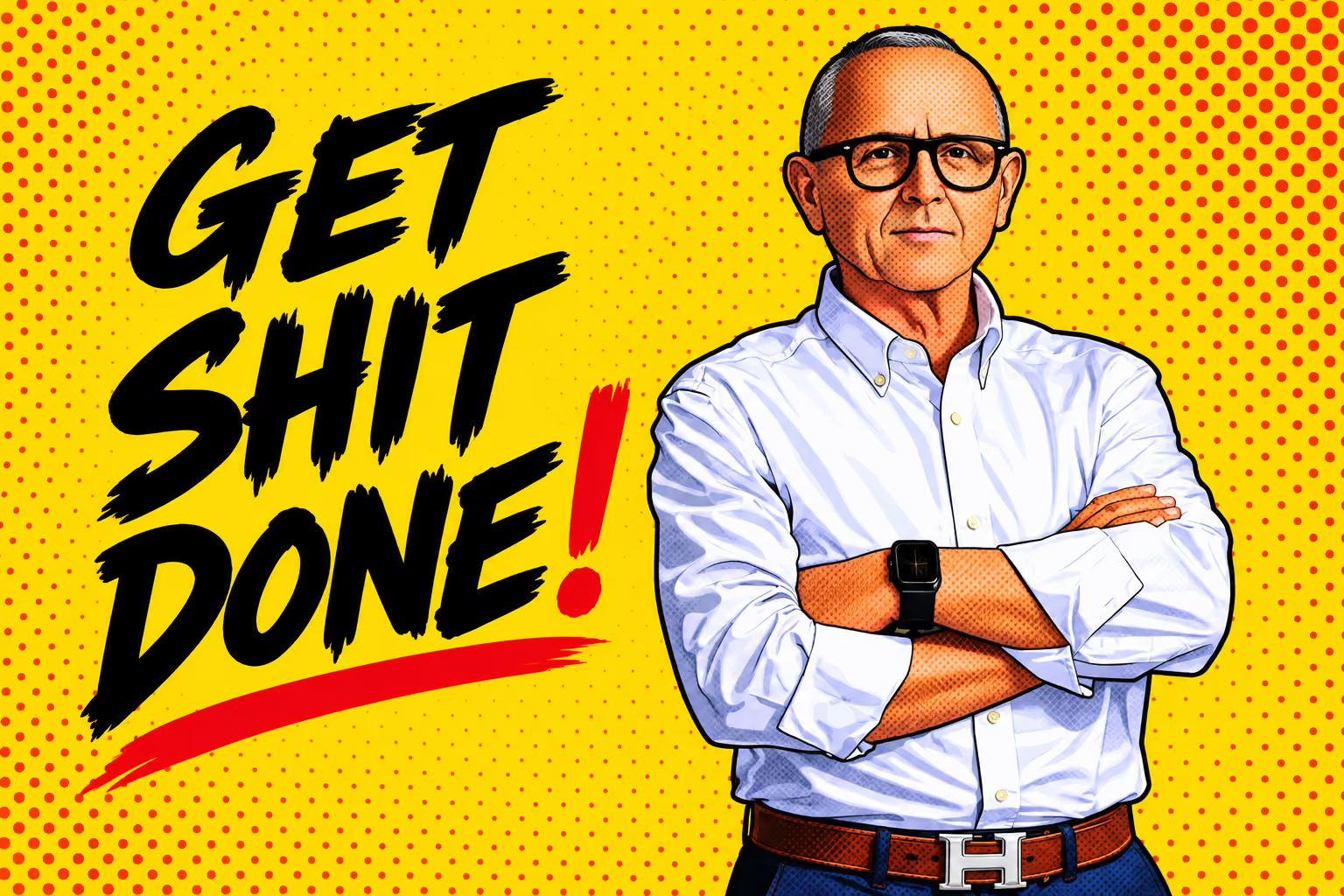
Here are my 10 rules for a ruthless, effective and efficient meeting culture:
1. KILL HALF OF YOUR MEETINGS.
Start there. Don’t optimize useless meetings. Eliminate them. If nobody can clearly explain what decision, action or result a recurring meeting produces, delete it.
2. STOP INVITING SPECTATORS.
A meeting is not a cinema. If 15 people are invited but only five actually contribute, ten people are wasting their time. Invite contributors, decision-makers and owners. Nobody else.
3. IF YOU HAVE NOTHING TO CONTRIBUTE, DON’T ATTEND.
Your calendar invitation is not a court summons. If you cannot contribute, decide or learn something essential, decline. And if you realize during the meeting that you are useless there: leave.
4. STOP TALKING TO YOURSELVES. GO TO THE CUSTOMER.
When internal meeting time massively exceeds customer-facing time, your priorities are upside down. Every hour of internal corporate self-entertainment has an opportunity cost. Spend more time where the business actually happens: in the market.
5. KILL REDUNDANCY.
Three meetings discussing the same topic with slightly different groups are not alignment. They are organizational incompetence. One topic. One owner. One discussion. One decision. One execution.
6. DON’T REPEAT WHAT SOMEBODY ELSE JUST SAID.
Corporate meetings are full of people rephrasing the previous speaker to demonstrate their own relevance. Stop it. If it has been said, it has been said. Add something or shut up.
7. NO MEETING WITHOUT AN OUTCOME.
Every meeting must have a purpose: decide something, solve something, create something or assign action.
“Exchange”, “alignment” and “update” are too often corporate camouflage for having no real objective. Meetings must produce movement.
8. CAMERAS ON. PERIOD.
In a virtual meeting, switching your camera off without a good reason is the digital equivalent of sitting in a conference room with your back turned to everyone. It signals distance and disengagement. If you attend, be present. Visibly.
9. DON’T CONFUSE A FULL CALENDAR WITH PERFORMANCE.
Eight meetings a day do not prove that you are important. They may prove that you have lost control of your time. Being permanently busy is not a badge of honor. Results are.
10. END WITH WHO DOES WHAT BY WHEN.
A meeting without clear actions, owners and deadlines was probably just a conversation.
No vague “we should”. No “somebody needs to”. Name the owner. Name the action. Name the deadline. Then execute.
You need to answer at the end of any smart meting the WHO - WHAT - WHEN!
:devider:
And one final thought:
Internal meetings do not create market share. Execution does. Customers do. Markets do.
So look at your calendar tomorrow morning.
Ask yourself three questions:
- Do I really need to be there?
- Does this meeting really need to exist?
- Would this hour create more value if I spent it with a customer?
Then start deleting.
Your calendar should not document how busy you are.
It should reveal what your priorities are.
- KILL MEETINGS.
- KILL REDUNDANCY.
- GET OUT INTO THE MARKET.
- AND GET SHIT DONE.
:devider:
The priority is so clear: Gettin' things done - achieving targets - make profitable business - win back or expand market shares!
If it doesn't assist achieving this - it's useless!


About Ulvi I. AYDIN
Ulvi I. AYDIN: Als international agierender Interim-CEO und -CSO unterstützt er mittelständische Unternehmen und Konzerne bei Marken- und Marktentwicklung, Neu-Positionierung, Organisations-Entwicklung, Restrukturierung und Vertriebsexzellenz.