Was hat ein CRM-System mit Selbstdisziplinierung zu tun?
August
4
,
2020
2020
In seiner Tätigkeit als Interim-Manager verpasst der unbequeme Wahrheiten-Sager Ulvi AYDIN Führungskräften, Vorständen, Gesellschaftern und Mitarbeitern den Tritt, den sie benötigen, um ihr Unternehmen auf Kurs zu bekommen.In dieser Folge klären wir Fragen wie: Warum ist das Kennen von KPIs für den Unternehmenserfolg wesentlich? Wie kann Digitalisierung zum Unternehmenserfolg beitragen? Was hat ein CRM-System mit Selbstdisziplinierung zu tun? Wer sollte entscheiden, welches CRM-System genutzt wird?Podcast:Siehe auch: SalesFive
*
Minuten
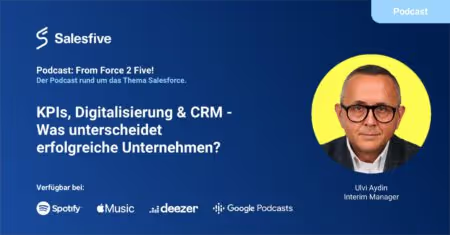
In seiner Tätigkeit als Interim-Manager verpasst der unbequeme Wahrheiten-Sager Ulvi AYDIN Führungskräften, Vorständen, Gesellschaftern und Mitarbeitern den Tritt, den sie benötigen, um ihr Unternehmen auf Kurs zu bekommen.In dieser Folge klären wir Fragen wie:
Warum ist das Kennen von KPIs für den Unternehmenserfolg wesentlich?
Wie kann Digitalisierung zum Unternehmenserfolg beitragen?
Was hat ein CRM-System mit Selbstdisziplinierung zu tun?
Wer sollte entscheiden, welches CRM-System genutzt wird?
The Will to Win
Everybody talks about goals.
I care much more about something else: What are you willing to do to achieve them?
Goals are easy. PowerPoint is easy. Analysis is easy. Explanations are easy.
Execution is hard.
Over decades in management, I have seen brilliant people explain perfectly why something went wrong. They analyze. They rationalize. They produce another slide deck.
And then?
Nothing happens.
I have far more respect for the person who says:
“I got it wrong. I underestimated it. I’ll fix it.”
And then gets to work.
Because in the end:
Discipline beats talent.
Consistency beats occasional brilliance.
Execution beats analysis without action.
Commitment beats excuses.
You don’t need to be the smartest person in the room. You don’t need the most impressive degree. You don’t need perfect conditions.
But you need something that cannot be taught easily:
The will to win.
I call it the Hunting Spirit.
That inner drive that makes you get up again. Attack the problem. Find another way. Make the call. Visit the customer. Take responsibility. Do today what others postpone until tomorrow.
Business can sometimes feel like a battlefield. And battlefields are not always won by those with the most resources.
They are often won by those with courage, discipline, speed, resilience, and the determination to keep moving.
Weak leaders explain endlessly.
Strong leaders take responsibility and act.
Kobe Bryant embodied this mentality: get up early, put in the work, repeat it relentlessly. No excuses. No shortcuts.
And listen carefully to the language people use:
Strong people say: “I will.” “I will do it.” “I will deliver.”
The moment responsibility disappears behind “we will,” “we should,” “we must,” or “we shall,” be careful. Collective responsibility too often becomes no responsibility at all.
Accountability is individual. It cannot be socialized.
Your goals don’t define you.
Your actions do.
And without the will to win, everything else is just decoration.
The AYCON Principles of Interim Management Excellence
Ulvi Aydin, one of the most experienced interim managers in the industry, lives by a simple principle: Love and knowledge are wonderful things—they double when you share them.
Drawing on 21 years of experience, approximately 25 assignments, and 15 industries, he shares these principles as inspiration, guidance, and a legacy for young and new interim managers.
Personality & Mindset
Take ownership from day one.
No one hires an interim manager to sit on the sidelines.
Remain independent in your judgment.
Your loyalty is to the success of the company, not to individual people.
Tell the truth, even when it is uncomfortable.
Diplomacy matters. Clarity matters more.
Earn trust through performance, not through titles.
Always maintain integrity and confidentiality.
Confidentiality is the currency of interim management.
Always act in the best interest of the company.
Not in the interest of individual stakeholders.
Selecting Assignments
Only accept assignments you are qualified to handle.
Experience cannot be improvised.
Critically assess every assignment before signing the contract.
Not every problem can be solved.
Turn down assignments when there is no realistic chance of success.
Integrity before revenue.
Define the objectives with absolute clarity before you start.
Clarify expectations, roles, and responsibilities early.
Never allow yourself to be drawn into political power games.
Starting the Assignment
Listen first. Act second.
Understand the numbers, the processes, and the people equally well.
Build an objective picture of the situation within the first 20 days.
Identify the three biggest levers for impact.
Deliver quick wins without falling into action for action’s sake.
Create transparency based on facts, not opinions.
Leadership & Execution
Lead by example, not by hierarchy.
Make decisions when others hesitate.
Focus on results, not activities.
Being busy is not progress.
Build structures that work without you.
Build ownership instead of dependency.
A good interim manager ultimately makes himself unnecessary.
Change processes, not just people.
Connect strategy with operational execution.
Consistently deliver on deadlines, quality, and budget.
That is simply part of being a professional.
Exit & Legacy
Measure success by sustainable results.
Ensure knowledge transfer before you leave.
Leave behind a stronger company than the one you found.
Your greatest success is when they no longer need you.
Interim management is not a permanent solution. It is about enabling the organization to succeed on its own.
Ulvi: The Essence in One Sentence
“An excellent interim manager creates clarity, trust, results, and sustainable structures in a short period of time—without creating dependency.”
*
Minuten
Clarity! Trust! Results! Executions!
Create Clarity! Create Trust! Deliver Results! Create a good and efficient Structure! Execute!
LOCAL EXCELLENCE MUST BECOME GLOBAL EXCELLENCE!
One of the biggest mistakes in global corporations is surprisingly simple:
Headquarters believes it knows best.
The strategy comes from headquarters.
The processes come from headquarters.
The standards come from headquarters.
And the countries are expected to execute.
That thinking is outdated.
Because headquarters does not own the truth.
The market does.
And the people closest to customers, competitors, projects, and opportunities often know things that headquarters simply cannot know.
That is why I believe global companies need a fundamental shift in mindset:
Stop treating countries as execution units. Start treating them as sources of intelligence.
During my current global assignment, I have spent considerable time in different countries and regions. And again and again, I see the same thing:
There is enormous competence out there.
India does things exceptionally well that Europe can learn from.
The Middle East has approaches that should influence global thinking.
Asia brings speed, ambition, and different ways of building relationships.
North America brings its own commercial logic and customer orientation.
South America operates successfully under conditions that require flexibility and entrepreneurship.
Italy may have solutions others have never considered.
And Germany recently provided another excellent example: instead of looking primarily at historical customer revenues, the team started looking at customer potential.
A small change in perspective.
But potentially a massive change in how sales resources are allocated.
That is exactly the point.
Great ideas do not carry headquarters ZIP codes.
If something works brilliantly in India, why shouldn't Germany learn from it?
If a sales approach succeeds in the Middle East, why shouldn't Europe test it?
If Germany develops a better way to identify customer potential, why shouldn't Brazil, the US, or South Korea use it?
A global organization should not be a one-way street where headquarters sends knowledge outward.
It should be a global learning machine.
Knowledge must travel in every direction.
Country to headquarters.
Country to country.
Region to region.
Market to market.
The role of headquarters is therefore not to have all the answers.
Its role is to create the system that identifies the best answers — wherever they emerge — and makes them available to everyone.
That is what real global leadership means.
Of course, we need common standards. We need common systems. We need common KPIs, processes, and a shared strategic direction.
But standardization must never destroy intelligence.
One strategy does not mean one answer.
India is not Germany.
Japan is not Brazil.
Saudi Arabia is not the United States.
South Korea is not Italy.
The cultures are different. The competitive environments are different. Customer expectations are different. Decision-making processes are different. Market maturity is different.
Pretending otherwise does not create alignment.
It creates blindness.
We therefore need more India in our headquarters DNA.
More Asia.
More Middle East.
More South America.
More North America.
More Italy.
More Germany.
Not because one region is better than another.
But because each of them knows something the others don't.
That is the power of diversity in a global organization.
Diversity is not primarily about having different nationalities around a conference table.
Diversity creates value when different experiences, market realities, ideas, and ways of working actually influence decisions.
When the best local idea becomes a global capability.
When one country's success becomes another country's shortcut.
When we stop asking:
“How can headquarters make the countries better?”
And start asking:
“What can each country teach the entire company?”
That changes everything.
Because the strongest global company is not the company with the smartest headquarters.
It is the company that is best at collecting, connecting, and scaling the intelligence of its entire organization.
The British eventually had to learn that looking at the world from the top down creates enormous blind spots. Global corporations should not need history to teach them the same lesson again.
Go into the markets.
Listen to the people.
Find what works.
Challenge your own assumptions.
Take the best from everywhere.
And make it available to everyone.
Local excellence must become global excellence.
Because in a truly global organization, the whole should not simply be the sum of its parts.
It should be stronger because of them.
*
Minuten
The Power of Diversity in a Global Organization.
When one country's success becomes another country's shortcut.
Companies spend an astonishing amount of time looking at themselves.
They discuss processes, structures, responsibilities, CRM systems, presentations, forecasts, budgets, approval loops, and organizational charts. They hold meetings about meetings and create reports about reports.
And eventually, they start believing that all of this represents reality.
It doesn’t.
The inside world of a company is always theory.
The outside world is the truth.
The truth is in the market.
It is with the customer.
It is with the people who sell, deliver, install, service, and negotiate every single day.
That is where reality happens.
And that is why great companies must learn to think from the outside in — never from the inside out.
Get Out of the Building
You cannot understand a market from a PowerPoint presentation.
You cannot understand customers from a CRM dashboard.
And you cannot understand your own organization by sitting in headquarters.
Data matters. Processes matter. Reports matter.
But they are representations of reality.
They are not reality itself.
The moment leaders confuse the map with the territory, organizations become dangerous to themselves. Decisions start being based on internal assumptions rather than external facts.
The antidote is surprisingly simple:
Get out.
Go where customers are.
Go where your salespeople are.
Go where your products are being used.
Watch.
Listen.
Ask questions.
And, most importantly, observe what is actually happening.
Reality Starts at the Bottom
Four Seasons understood this remarkably well.
Executives were temporarily required to perform some of the most basic jobs in the hotel: carrying luggage, washing dishes, inspecting rooms, and experiencing the daily operation from the ground up.
Why?
Because a management report can tell you that hotel operations are running smoothly.
Reality may tell you that a guest has been waiting 20 minutes.
A KPI can tell you that room quality is excellent.
Reality may show you a bathroom that is not properly cleaned.
A presentation can tell you that processes are efficient.
Reality may show you an employee struggling every day with a process designed by someone sitting hundreds of miles away.
The spreadsheet shows the theory. The hotel floor shows the truth.
Once executives experience the business from the bottom up, their questions change.
They stop discussing abstract processes and start asking about waiting times, bathrooms, workflows, customers, and employees.
They have seen reality with their own eyes.
Stop Looking From the Inside Out
This is where many companies go wrong.
They develop a product — and then ask how to sell it.
They create a process — and then force the market to follow it.
They define a strategy — and then expect customers and countries to fit into it.
That is backwards.
Do not start with what you have. Start with what is happening outside.
What is the customer trying to achieve?
What is changing in the market?
Where is the customer frustrated?
What are competitors doing better?
What do our people in the field see that headquarters does not?
Only then should the organization turn inward and ask:
What do we need to change?
That is outside-in thinking.
And it requires discipline because organizations naturally gravitate toward themselves. Internal topics are comfortable. They are controllable. They create calendars full of meetings and the comforting feeling of being busy.
The market does not care.
Focus on What Is Real
Leadership therefore also means concentration.
Concentrate on the few things outside the organization that actually determine success.
Customers.
Markets.
Competitors.
Value.
Execution.
Everything inside the company should serve those realities.
Processes are not the purpose.
Organizations are not the purpose.
CRM is not the purpose.
Meetings are certainly not the purpose.
They are tools. Nothing more.
The moment the tool becomes more important than the outside-world result it was created to achieve, bureaucracy begins.
And bureaucracy is nothing more than an organization becoming increasingly fascinated with itself.
The Market Always Has the Final Word
There is one brutal advantage to the outside world:
It does not care about our explanations.
Customers do not care how difficult our internal processes are.
Competitors do not care about our organizational restructuring.
The market does not care how beautiful our strategy presentation looks.
At the end of the day, there is only one question:
Did we create enough value to win?
That answer will never be found exclusively inside headquarters.
So stop staring into the corporate mirror.
Go outside.
Observe.
Listen.
Understand.
Then come back inside and change whatever needs to be changed.
Because the inside world is theory.
The outside world is the truth.
Wenn Sie auf "Alle Cookies akzeptieren" klicken, stimmen Sie der Speicherung von Cookies auf Ihrem Gerät zu, um die Navigation auf der Website zu verbessern, die Nutzung der Website zu analysieren und unsere Marketingmaßnahmen zu unterstützen. Weitere Informationen finden Sie in unserer Datenschutzrichtlinie.