Type image caption here (optional)NS-Raubkunst im Kunsthandel transparent machen!Heute spreche ich im Experten-Talk mit Simon Braun über den Kunsthandel, NS-Raubkunst und den spektakulären Restitutionsfall von Carl Spitzwegs Justitia, einem Werk aus der Spätromantik und Biedermeier-Zeit. Simon ist ein Young Professional im Bereich Kulturmanagement. 2019 und 2020 war er für die Agentur Goldmann Public Relations maßgeblich an der Kommunikationskampagne zur Restitution und Versteigerung der Justitia beteiligt – die nach langer Zeit endlich ihren rechtmäßigen Erben zurückgegeben werden konnte.Simon, als Laie erfährt man über den Kunsthandel eigentlich immer nur dann etwas, wenn mal wieder ein Kunstwerk für astronomische Summen versteigert wurde. Kannst Du uns einmal in Elevator-Pitch-Manier ein grobes Bild über den Wirtschaftssektor „Kunsthandel“ zeichnen?Man unterteilt den Kunsthandel grundsätzlich in zwei Bereiche: den Primärmarkt und den Sekundärmarkt. Der Primärmarkt setzt sich aus Sammlern und Galerien zusammen. Die Galerien vertreten die Künstler, die Künstler produzieren (wirtschaftlich ausgedrückt) die Ware. Die Sammler hängen sich die Kunstwerke an die Wand: Als Zukunftsinvestition, Ausdruck eines Lifestyles oder einfach, weil sie sich mit der Kunst identifizieren. Der Sekundärmarkt besteht aus den Kunsthändlern und Auktionshäusern. 2018 lag der Jahresumsatz für den weltweiten Sektor „Kunsthandel“ bei ca. 67 Mrd. Euro, in Deutschland bei etwa zwei Milliarden. Die USA, China und Großbritannien dominieren den Markt. Der Auktionsmarkt hatte 2018 alleinstehend einen Umsatz von 30 Mrd. Euro. Es gibt wenige große Player und ganz viele kleine – aber praktisch nichts dazwischen.Welche Auswirkung hatte der Corona-Lockdown auf die Auktionshäuser?Schon vor Corona gab es Online-Auktionen. Während des Lockdowns begannen viele Häuser, diese weiter auszubauen. Aber sowohl Anbieter also auch Bieter sind sich im großen Maße einig: Was eine Auktion ausmacht, sind die Geschehnisse im Auktionssaal. Bei uns war die Auktion von Carl Spitzwegs Justitia eine der ersten Auktionen nach dem Lockdown, die wieder physisch stattfanden. Das Haus hatte sich für eine hybride Lösung entschieden: Ein Teil der Bieter war vor Ort und ein anderer Teil konnte online mitbieten.Von den hohen Preisen im Kunsthandel werden doch bestimmt auch Fälscher angelockt, die versuchen ihre falschen echten Meister zu verkaufen, oder? Ich erinnere mich an Han van Meegeren, der in den 30er und 40er Jahren mehrere Vermeer-Fälschungen verkaufte – unter anderem an Herman Göring.Kunstfälschung hat sich in der Tat zu einer Art Berufsbild entwickelt - von Menschen, die auch im Fahrwasser des Marktes und des Geldes mitschwimmen wollen. Das geht von Signaturfälschung bis hin zu kompletter Neuschaffung von Gemälden, die dann als wiederentdeckte Objekte deklariert werden, wie bei Han van Meegeren oder, etwas aktueller, bei Wolfgang Beltracchi. Dennoch handelt es sich hierbei schon eher um organisiertes Verbrechen: Neben der Fälschung benötigt man meist einen Anwalt oder einen Gutachter sowie einen Galeristen, der das Werk vertritt – und diese Leute sollten in der Regel nach ihrem Gewissen handeln, was ja auch die meisten tun. Der Kunstmarkt ist hochprofessionell, man kennt diese Fälscher-Geschichten und jedes Museum und Auktionshaus hat seine eigenen Experten für Genre, Gattung, Künstler oder Techniken. Das sind detektivische Wissenschaftler, die Bilder röntgen und deren Pigmentierung analysieren. Man kann Fälschungen nicht komplett verhindern, aber es wird immer schwieriger für die Fälscher.Im Nationalsozialismus raubten die Nazis zahlreiche Kunstwerke. Die Opfer des Raubs waren vor allem verfolgte Juden. Der NS-Kunstraub wird auf 600.000 Kunstwerke geschätzt. Wie laufen die Prozesse der Rückgabe (Restitution) an die die rechtmäßigen Eigentümer ab?This photo provided by The Monuments Men Foundation for the Preservation of Art of Dallas, shows Monuments Man James Rorimer, with notepad, as he supervises American GI's hand-carrying paintings down the steps of the castle in Neuschwanstein, Germany in May of 1945. (photo credit: AP/National Archives and Records Administration)Bis heute gibt es noch ca. 100.000 Werke mit ungeklärter Provenienz (Herkunft). Es gibt Datenbanken und Institutionen, wie das Deutsche Zentrum Kulturgutverluste, die sich um solche Themen kümmern. Restitution ist aber eine rechtlich ziemlich schwierige Auseinandersetzung um Eigentum – und damit verwickelt sind menschliche Schicksale. Es gibt als Grundlage eine Selbstverpflichtung zur Aufarbeitung: 1998 wurden international die Washingtoner Prinzipien verabschiedet, in denen diese Selbstverpflichtung postuliert ist. Deutschland hat noch zusätzlich eine Handreichung mit Praxisempfehlungen verabschiedet, wie man mit Werken ungeklärter Herkunft umgehen sollte.Rechtlich ist das allerdings wenig bis gar nicht bindend. Es geht um den freien Willen der vermeintlichen Eigentümer. Wenn die rechtlichen Besitzansprüche geklärt sind, kann man die Herausgabe der Bilder verlangen. Allerdings verjähren die Ansprüche nach 30 Jahren. In der Praxis sind das Angelegenheiten, die extrem schwierig, langwierig und zäh sind und am Ende oft mit außergerichtlichen Einigungen geregelt werden.In Deutschland gibt es eine Arbeitsstelle für Provenienzforschung mit einem Jahresbudget von 2 Mio. Euro, die nur dafür da sind, solche Verhältnisse aufzuspüren. Mittlerweile gibt es auch Lehrstühle und private wie institutionelle Forscher, die sich damit beschäftigen – jedes größere Museum hat einen hauseigenen Provenienzforscher. In der Regel sind dies Kunsthistoriker und Rechtsanwälte. In unserem Fall hat sich ein Forscherteam durch Akten in halb Europa gewühlt, um herauszufinden, wie es um die Provenienz der Justitia steht.Erzähl uns die Story der Restitution der JustitiaCarl Spitzweg, „Justitia“, 1857 / Quelle: Neumeister/Christian MitkoGoldmann Public Relations ist eine führende PR-Agentur im Bereich Kunst und Kultur, mit Sitzen in Berlin, München und Zürich. Die Agentur bewegt sich im Handlungs- und Vermittlungsfeld zwischen Kultur, Wirtschaft und Medien. Während meiner Zeit kam das Münchner Auktionshaus „Neumeister“ auf uns zu. Nachdem die Eigentümerin das Haus von ihrem Vater übernommen hatte, ließ sie dessen gesamte Geschichte aufarbeiten. Fast jedes Auktionshaus, das während der NS-Zeit existierte oder existieren durfte, hat seine dunklen Seiten in der Geschichte. Auch das Auktionshaus Neumeister hat im Keller brisantes Material gefunden. Die Eigentümerin wollte so transparent wie möglich damit umgehen – und entschloss sich, die eigene Geschichte und die Provenienz bedeutsamer Werke von Forschern aufarbeiten zu lassen und damit an die Öffentlichkeit zu gehen. Damit ist das Auktionshaus Neumeister zum Pionier in Sachen Aufarbeitung von NS-Raubkunst geworden – denn viele Häuser ignorieren die ungeklärte Herkunft vieler ihrer Werke. Es war bis dato ein Tabuthema.Mit welchem Auftrag kam das Haus Neumeister auf euch zu?Das Auktionshaus Neumeister stand vor dem Fall Justitia. Sie wollten die Geschichte transparent machen, wussten aber nicht genau, wie. Also halfen wir ihnen, diese Geschichte zu erzählen und produktive Wege zu finden. Das Hauptziel war, die Geschichte der Besitzverhältnisse zu erzählen und klarzustellen, wer der ursprüngliche Eigentümer der Justitia war, bzw. wer die rechtmäßigen Erben sind.Was hat es mit dem Werk auf sich?Das Werk Justitia des Malers Carl Spitzweg ist ein Raubkunstfall, an dem exemplarisch die Dramatik, Tragweite und auch die Entwicklungsmöglichkeiten der Provenienzforschung deutlich werden. Denn wenn wir zurückschauen, handelt es sich um ein Gemälde, dessen ursprünglicher Besitzer – der jüdische Kunstsammler Leo Bendel – fliehen und im KZ sterben musste.Leo und Else Bendel kurz nach ihrer Ankunft in Wien. (Foto: Privatarchiv / Karl-Werner Quarg / Elisabeth Sandmann Verlag)Carl Spitzweg war Hitlers Lieblingsmaler. Das Bild, das Bendel unter Zwang der Nazis zu einem Spottpreis verkaufen musste, sollte in das geplante Führermuseum nach Linz gebracht werden. Der Verkaufspreis war niedrig, sodass Freiwilligkeit ausgeschlossen werden kann. Zwar hat Bendel theoretisch sein Eigentum an die Nazis übertragen. Aber unter diesem Kontext ist das natürlich mehr als zynisch. Heute spricht man von NS-verfolgungsbedingtem Verlust. Niemand hätte das Werk für diesen Preis verkauft. Die Ironie dabei ist, dass das Bild einen hochpolitischen Inhalt hat: Zu sehen ist eine Justitia mit verrutschter Augenbinde und kaputter Waage. Im Hintergrund lugt ein Wachmann um die Ecke. Die Aussage ist deutlich: Die Gerechtigkeit bröckelt.Als die Alliierten endlich die Oberhand im Krieg gewannen, wurde das Werk von den Nazis mit anderen Gemälden in einem Bergwerk versteckt, um es vor Bombeneinschlägen zu schützen. Später wurde es dann von alliierten Monuments Men gefunden und zum Central Collecting Point der Alliierten nach München gebracht. Dort konnte man aufgrund eines Schreibfehlers den Besitzer nicht mehr feststellen. So kam das Bild dann erst zum bayrischen Ministerpräsidenten und dann später, 1961, in die Villa Hammerschmidt des Bundespräsidialamtes, wo es bis 2006 die Amtsräume von acht Bundespräsidenten schmückte – von Heinrich Lübke bist Horst Köhler.Wahnsinn!Auch das ist eine Pointe, dass das Werk so lange im Bundespräsidialamt hing! 2006/2007 wurde dann ein Antrag zur Restitution gestellt, dem Horst Köhler auch stattgegeben hat. Aber dann ging es noch einmal richtig los.Wie meinst Du das? Es dauerte noch einmal zwölf Jahre, bis das Bild dann 2019 an die rechtmäßigen Erben ging. Köhler hatte den Antrag zwar unterzeichnet. Allerdings zeigte der deutsche Beamtenapparat dann sein hässliches Gesicht und stellte immer neue juristische und bürokratische Hürden. Die Nichte der Frau des Besitzers Leo Bendel war rechtmäßige Erbin. Sie ist während des Restitutionsprozesses allerdings verstorben. So musste ein neuer Erbantrag gestellt werden. Und vonseiten der Bürokratie kamen Forderungen nach der Geburtsurkunde von Leo Bendel. Seine Geburtsstadt in Polen wurde von den Nazis dem Erdboden gleich gemacht. Wie soll man da eine Geburtsurkunde einholen?Der Besitzerin des Auktionshauses Neumeister und Goldmann PR war es wichtig, dafür zu kämpfen, solche Hürden abzubauen und gemeinsam mit der Politik solche Restitutionsprozesse produktiver zu gestalten. Darum haben wir auch eine Tagung mit unterschiedlichen Akteuren und Interessensgruppen dazu veranstaltet, um eine zielführende Diskussion zu ermöglichen.Vielen Dank, Simon!Bringing Light to Nazi-looted Art within the Art Sector / Art TradeIn today’s expert-talk, I am speaking with Simon Braun about the art sector, Nazi-looted art and the spectacular restitution case of Carl Spitzweg’s Justitia (Lady Justice), a painting from the Late-Romantic and Biedermeier era. Simon is a young professionalworking in cultural management. In 2019 and 2020, he played a decisive role in the communication campaign for the restitution and auction of Justitia, which after a long time was returned to its rightful heirs at last.Simon, as a lay person you only ever hear about the art sector when an artwork is auctioned for a staggering amount of money. Can you give as us an elevator pitch on what the art trade looks like as an economic sector? You can generally divide the art sector into two areas: the primary market and the secondary market. The primary market consists of collectors and galleries. Galleries represent artists and artists produce the goods, economically speaking. Collectors put the works on their walls: as future investment, expression of a lifestyle or simply because they identify with the artwork. The secondary market is made up of art dealers and auction houses. In 2018, the total revenue in the art sector amounted to 67 billion euros worldwide and around two billion euros in Germany. The market is dominated by the USA, China and the UK. The auction market alone had a revenue of 30 billion euros in 2018. There are very few big players and many small ones – but hardly anything in between.How did the Covid-19 lockdown impact auction houses?There already had been online auctions before Covid-19. During the lockdown, many houses began to expand them. Still, both sellers and buyers are largely unanimous: What makes the appeal of an auction is the live-action in the room. Our auction of Carl Spitzweg’s Justitia was one of the first auctions in front of an audience after the shutdown. The house went for a hybrid-solution: a part of the bidders was physically present, the other part could bid online.Surely, high prices in the art trade must attract many forgers who try to sell their fake masterpieces? I remember Han van Meegeren, who sold multiple fake Vermeer-paintings during the 1930s and 1940s – to the leading Nazi politician Herman Göring, among others.Art forgery has indeed become a kind of profession – for people who want to benefit from the market and the money in it. This ranges from faking signatures to creating completely new paintings which are then declared as rediscovered works, as in the case of Han van Meegeren or, more recently, Wolfgang Beltracchi. Of course, this rather falls in the category of organized crime: apart from the fake painting, you would need an attorney or third-party assessor as well as a gallerist who represents the work – and these experts are held to act to the best of their knowledge and belief, which most of them do. The art market today is highly professional. These stories of forgery are known and so every museum and auction house has its own experts for different genres, eras, artists or techniques. They are detective-like scientists who X-ray canvases and analyse their colour pigmentation. Fakes cannot be stopped completely, but it is getting harder and harder for forgers.During National Socialism, the Nazis looted many works of art. Above all, the victims were persecuted Jews. Estimates range at around 600.000 stolen works. What does the process of returning the works to their rightful owners (restitution) look like?This photo provided by The Monuments Men Foundation for the Preservation of Art of Dallas, shows Monuments Man James Rorimer, with notepad, as he supervises American GI's hand-carrying paintings down the steps of the castle in Neuschwanstein, Germany in May of 1945. (photo credit: AP/National Archives and Records Administration)Today, we still count around 100.000 works with ambiguous provenance. There are databanks and institutions such as the German Lost Art Foundation who deal with these issues. However, restitution proves to be a rather difficult legal contention around the issue of property – deeply intertwining with human fates. As a basis, the Washington Principles, an international self-commitment to come to terms with and solve these cases, have been enacted. Additionally, Germany has published a recommendation providing practical steps on how to handle works with unclear provenance.Legally however, they are hardly binding at all. Above all else, it comes down to the current owner’s free will. After clarifying the ownership claims, the return of a painting can be demanded. However, original entitlement to possession expires after 30 years. In reality, these cases turn out to be extremely difficult and lengthy, which is why in the end they are often resolved in settlements out of court.The German government has an office for provenance research with a yearly budget of 2 million euros, which solely traces out such cases. By now, there are also dedicated university departments and both private and institutional investigators. Every larger museum has its own provenance researcher. Usually, those are art historians or lawyers. In our case, a team of researchers dug through files and records in half of Europe in order to discover the exact provenance of Justitia.Tell us the restitution story of JustitiaCarl Spitzweg, „Justitia“, 1857 / Quelle: Neumeister/Christian MitkoGoldmann Public Relations is a leading PR-agency in the Arts & Culture sector with offices in Berlin, Munich and Zurich. The firm acts as a mediator and communicator between the sectors of art, business and the media. During my employment, Neumeister Auctioneers, Munich approached us. After succeeding her father in managing the house, the owner had its entire history researched and made transparent. Nearly every auction house that existed or was allowed to exist during National Socialism, has some dark sides to its history. Likewise, Neumeister discovered highly sensitive material in its basement. Wishing to treat the material as transparently as possible, the owner decided to let scientists research the house’s history as well as the provenance of significant works and to make them public. This way, the auction house became a pioneer in dealing with Nazi-looted art, since many other houses often ignore unexplained parts in the provenance of its artworks. Until then, the issue had been more or less taboo.What mission did the auction house entrust to you?Neumeister was confronted with the case of Justitia. They wanted to make its history publicly transparent, but did not know how. So we helped them tell the story and find productive ways of dealing with the issues surrounding it. The main goal was to narrate the history of its ownership and clarify who rightfully owns it.What is the story behind the artwork? Carl Spitzweg’s painting Justitia is a case of Nazi-looted art that exemplifies the drama as well as the scale and consequences, but also the potential for development that lie in the field of provenance research. Looking closer, we discover a painting whose original owner – the Jewish art collector Leo Bendel – was forced to flee and who eventually died in a concentration camp.Leo und Else Bendel kurz nach ihrer Ankunft in Wien. (Foto: Privatarchiv / Karl-Werner Quarg / Elisabeth Sandmann Verlag)Carl Spitzweg was Hitler’s favourite painter. The work, that Bendel sold under duress of the Nazis at a ridiculous price, was intended to feature in Hitler’s planned ‘Führermuseum’ in Linz, Austria. The price was low, therefore the possibility of a voluntary sale can be excluded. On a theorical level, Bendel did transfer his property to the Nazis. In this context, such an assumption would of course be cynical. Today, we describe this as a loss resulting from persecution. No one would have given away the work unless pressurized by such circumstances. The irony is that the painting has a highly political subject matter: it depicts a statue of Lady Justice whose blindfold has slipped and whose scales are broken. In the background, a police officer suspiciously lurks at the viewer. The message is clear: justice is disintegrating.When the Allied forces gained the upper hand in the war, this work and other paintings were hid away by the Nazis in an abandoned mine to protect them from the bombs. Later, allied Monuments Men discovered it and brought it to the american Central Collecting Point in Munich. Due to an error in spelling, the owner could not be determined. Subsequently, the painting was handed to the Bavarian Prime Minister and then later, in 1961, to the Villa Hammerschmidt – the Office of the German Federal President – where it decorated the offices of eight Federal Presidents: from Heinrich Lübke to Horst Köhler.Unbelievable! Quite ironic indeed, that the work hung on the walls of the German Federal President for such a long time. In 2006/2007, the rightful heirs filed a claim for restitution, which was granted by Horst Köhler. But then, things really took off once more.How do you mean?It would take another twelve years until the painting was returned to the rightful heirs in 2019. Köhler did grant the restitution, but then German bureaucracy revealed its true face and posed ever new legal and administrative obstacles. The niece of Leo Bendel’s wife was the rightful heir. However, she passed away during the restitution process. A new application for inheritance had to be filed. The bureaucracy insistently demanded a birth certificate of Leo Bendel, whose native town in Poland had been eradicated to the ground by the Nazis. How should you come up with a birth certificate there?It was a concern of the auction house Neumeister and of Goldmann Public Relations to fight for the removal of such barriers and, in collaboration with political actors, to increase the productivity of restitution processes. This is why we also hosted a conference with various actors and stakeholders on the matter, in order to enable a goal-oriented discussion.Thank you very much, Simon!
*
Minuten
NS-Raubkunst im Kunsthandel transparent machen!
Heute spreche ich im Experten-Talk mit Simon Braun über den Kunsthandel, NS-Raubkunst und den spektakulären Restitutionsfall von Carl Spitzwegs Justitia, einem Werk aus der Spätromantik und Biedermeier-Zeit. Simon ist ein Young Professional im Bereich Kulturmanagement. 2019 und 2020 war er für die Agentur Goldmann Public Relations maßgeblich an der Kommunikationskampagne zur Restitution und Versteigerung der Justitia beteiligt – die nach langer Zeit endlich ihren rechtmäßigen Erben zurückgegeben werden konnte.
Simon, als Laie erfährt man über den Kunsthandel eigentlich immer nur dann etwas, wenn mal wieder ein Kunstwerk für astronomische Summen versteigert wurde. Kannst Du uns einmal in Elevator-Pitch-Manier ein grobes Bild über den Wirtschaftssektor „Kunsthandel“ zeichnen?
Man unterteilt den Kunsthandel grundsätzlich in zwei Bereiche: den Primärmarkt und den Sekundärmarkt. Der Primärmarkt setzt sich aus Sammlern und Galerien zusammen. Die Galerien vertreten die Künstler, die Künstler produzieren (wirtschaftlich ausgedrückt) die Ware. Die Sammler hängen sich die Kunstwerke an die Wand: Als Zukunftsinvestition, Ausdruck eines Lifestyles oder einfach, weil sie sich mit der Kunst identifizieren. Der Sekundärmarkt besteht aus den Kunsthändlern und Auktionshäusern. 2018 lag der Jahresumsatz für den weltweiten Sektor „Kunsthandel“ bei ca. 67 Mrd. Euro, in Deutschland bei etwa zwei Milliarden. Die USA, China und Großbritannien dominieren den Markt. Der Auktionsmarkt hatte 2018 alleinstehend einen Umsatz von 30 Mrd. Euro. Es gibt wenige große Player und ganz viele kleine – aber praktisch nichts dazwischen.
:devider:
Welche Auswirkung hatte der Corona-Lockdown auf die Auktionshäuser?
Schon vor Corona gab es Online-Auktionen. Während des Lockdowns begannen viele Häuser, diese weiter auszubauen. Aber sowohl Anbieter also auch Bieter sind sich im großen Maße einig: Was eine Auktion ausmacht, sind die Geschehnisse im Auktionssaal. Bei uns war die Auktion von Carl Spitzwegs Justitia eine der ersten Auktionen nach dem Lockdown, die wieder physisch stattfanden. Das Haus hatte sich für eine hybride Lösung entschieden: Ein Teil der Bieter war vor Ort und ein anderer Teil konnte online mitbieten.
:devider:
Von den hohen Preisen im Kunsthandel werden doch bestimmt auch Fälscher angelockt, die versuchen ihre falschen echten Meister zu verkaufen, oder? Ich erinnere mich an Han van Meegeren, der in den 30er und 40er Jahren mehrere Vermeer-Fälschungen verkaufte – unter anderem an Herman Göring.
Kunstfälschung hat sich in der Tat zu einer Art Berufsbild entwickelt - von Menschen, die auch im Fahrwasser des Marktes und des Geldes mitschwimmen wollen. Das geht von Signaturfälschung bis hin zu kompletter Neuschaffung von Gemälden, die dann als wiederentdeckte Objekte deklariert werden, wie bei Han van Meegeren oder, etwas aktueller, bei Wolfgang Beltracchi. Dennoch handelt es sich hierbei schon eher um organisiertes Verbrechen: Neben der Fälschung benötigt man meist einen Anwalt oder einen Gutachter sowie einen Galeristen, der das Werk vertritt – und diese Leute sollten in der Regel nach ihrem Gewissen handeln, was ja auch die meisten tun. Der Kunstmarkt ist hochprofessionell, man kennt diese Fälscher-Geschichten und jedes Museum und Auktionshaus hat seine eigenen Experten für Genre, Gattung, Künstler oder Techniken. Das sind detektivische Wissenschaftler, die Bilder röntgen und deren Pigmentierung analysieren. Man kann Fälschungen nicht komplett verhindern, aber es wird immer schwieriger für die Fälscher.
:devider:
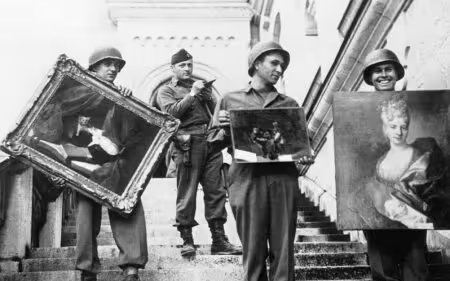
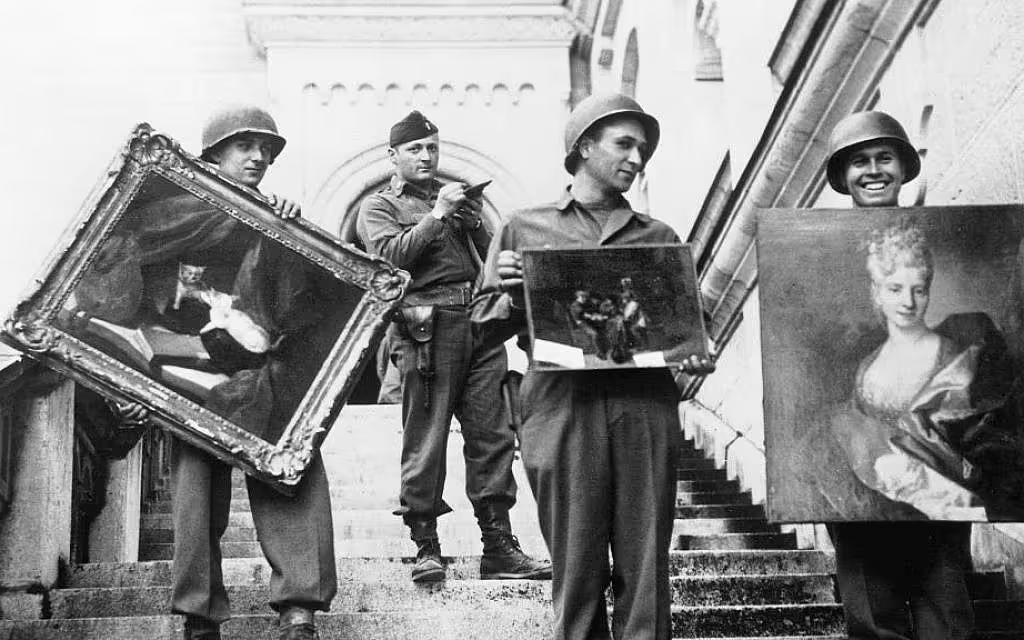
Im Nationalsozialismus raubten die Nazis zahlreiche Kunstwerke. Die Opfer des Raubs waren vor allem verfolgte Juden. Der NS-Kunstraub wird auf 600.000 Kunstwerke geschätzt. Wie laufen die Prozesse der Rückgabe (Restitution) an die die rechtmäßigen Eigentümer ab?
photo credit: AP/National Archives and Records Administration)
This photo provided by The Monuments Men Foundation for the Preservation of Art of Dallas, shows Monuments Man James Rorimer, with notepad, as he supervises American GI's hand-carrying paintings down the steps of the castle in Neuschwanstein, Germany in May of 1945.
Bis heute gibt es noch ca. 100.000 Werke mit ungeklärter Provenienz (Herkunft). Es gibt Datenbanken und Institutionen, wie das Deutsche Zentrum Kulturgutverluste, die sich um solche Themen kümmern. Restitution ist aber eine rechtlich ziemlich schwierige Auseinandersetzung um Eigentum – und damit verwickelt sind menschliche Schicksale. Es gibt als Grundlage eine Selbstverpflichtung zur Aufarbeitung: 1998 wurden international die Washingtoner Prinzipien verabschiedet, in denen diese Selbstverpflichtung postuliert ist. Deutschland hat noch zusätzlich eine Handreichung mit Praxisempfehlungen verabschiedet, wie man mit Werken ungeklärter Herkunft umgehen sollte.Rechtlich ist das allerdings wenig bis gar nicht bindend. Es geht um den freien Willen der vermeintlichen Eigentümer. Wenn die rechtlichen Besitzansprüche geklärt sind, kann man die Herausgabe der Bilder verlangen. Allerdings verjähren die Ansprüche nach 30 Jahren. In der Praxis sind das Angelegenheiten, die extrem schwierig, langwierig und zäh sind und am Ende oft mit außergerichtlichen Einigungen geregelt werden.In Deutschland gibt es eine Arbeitsstelle für Provenienzforschung mit einem Jahresbudget von 2 Mio. Euro, die nur dafür da sind, solche Verhältnisse aufzuspüren. Mittlerweile gibt es auch Lehrstühle und private wie institutionelle Forscher, die sich damit beschäftigen – jedes größere Museum hat einen hauseigenen Provenienzforscher. In der Regel sind dies Kunsthistoriker und Rechtsanwälte. In unserem Fall hat sich ein Forscherteam durch Akten in halb Europa gewühlt, um herauszufinden, wie es um die Provenienz der Justitia steht.
:devider:
Erzähl uns die Story der Restitution der Justitia
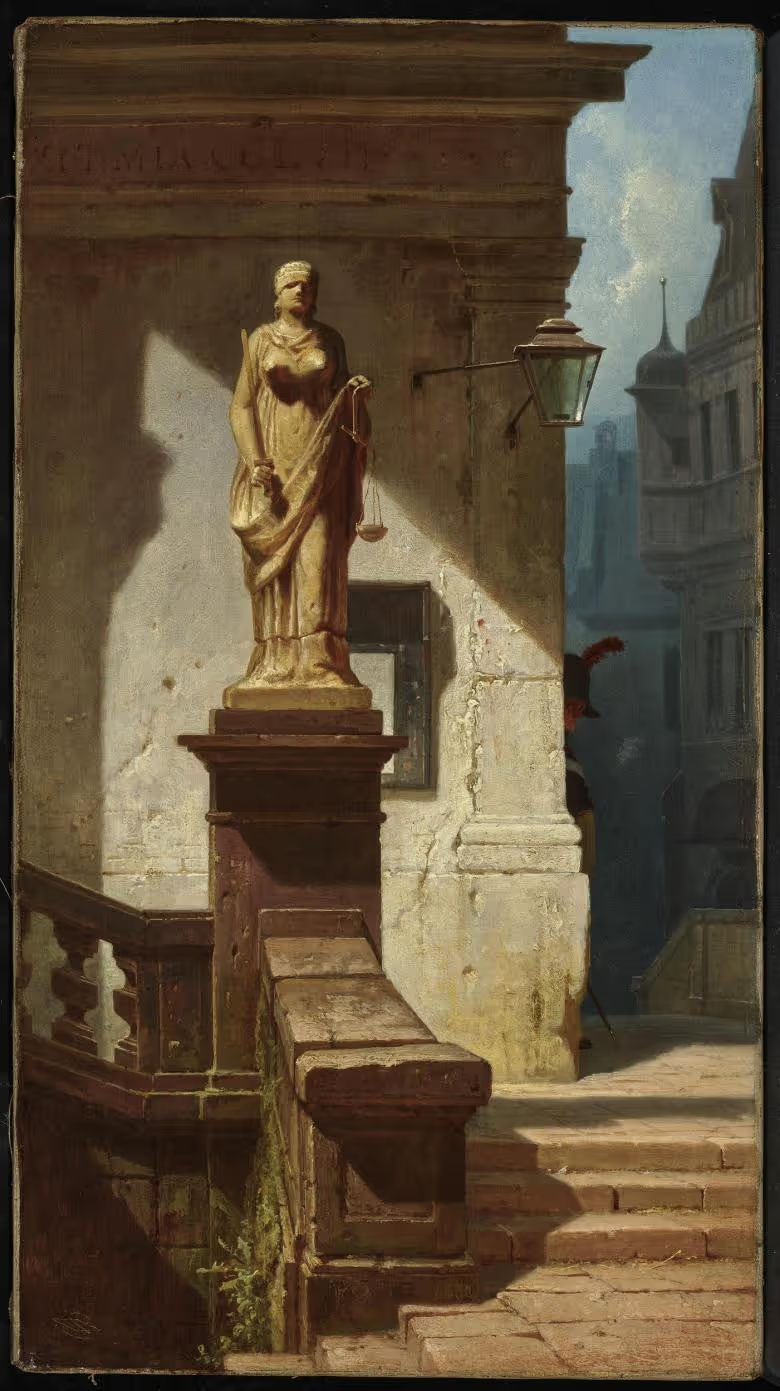
Carl Spitzweg, „Justitia“, 1857 / Quelle: Neumeister/Christian Mitko
Goldmann Public Relations ist eine führende PR-Agentur im Bereich Kunst und Kultur, mit Sitzen in Berlin, München und Zürich. Die Agentur bewegt sich im Handlungs- und Vermittlungsfeld zwischen Kultur, Wirtschaft und Medien. Während meiner Zeit kam das Münchner Auktionshaus „Neumeister“ auf uns zu. Nachdem die Eigentümerin das Haus von ihrem Vater übernommen hatte, ließ sie dessen gesamte Geschichte aufarbeiten. Fast jedes Auktionshaus, das während der NS-Zeit existierte oder existieren durfte, hat seine dunklen Seiten in der Geschichte. Auch das Auktionshaus Neumeister hat im Keller brisantes Material gefunden. Die Eigentümerin wollte so transparent wie möglich damit umgehen – und entschloss sich, die eigene Geschichte und die Provenienz bedeutsamer Werke von Forschern aufarbeiten zu lassen und damit an die Öffentlichkeit zu gehen. Damit ist das Auktionshaus Neumeister zum Pionier in Sachen Aufarbeitung von NS-Raubkunst geworden – denn viele Häuser ignorieren die ungeklärte Herkunft vieler ihrer Werke. Es war bis dato ein Tabuthema.
:devider:
Mit welchem Auftrag kam das Haus Neumeister auf euch zu?
Das Auktionshaus Neumeister stand vor dem Fall Justitia. Sie wollten die Geschichte transparent machen, wussten aber nicht genau, wie. Also halfen wir ihnen, diese Geschichte zu erzählen und produktive Wege zu finden. Das Hauptziel war, die Geschichte der Besitzverhältnisse zu erzählen und klarzustellen, wer der ursprüngliche Eigentümer der Justitia war, bzw. wer die rechtmäßigen Erben sind.
:devider:
Was hat es mit dem Werk auf sich?
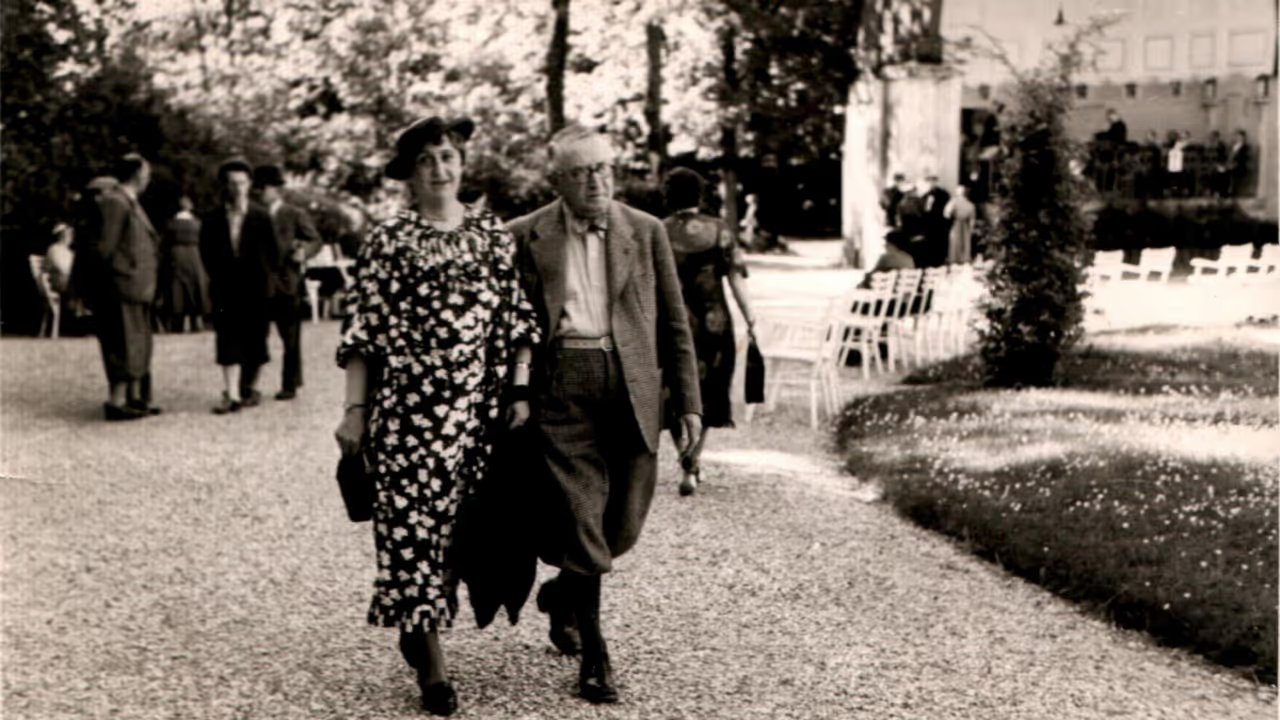
Das Werk Justitia des Malers Carl Spitzweg ist ein Raubkunstfall, an dem exemplarisch die Dramatik, Tragweite und auch die Entwicklungsmöglichkeiten der Provenienzforschung deutlich werden. Denn wenn wir zurückschauen, handelt es sich um ein Gemälde, dessen ursprünglicher Besitzer – der jüdische Kunstsammler Leo Bendel – fliehen und im KZ sterben musste.
Leo und Else Bendel kurz nach ihrer Ankunft in Wien. (Foto: Privatarchiv / Karl-Werner Quarg / Elisabeth Sandmann Verlag)
Carl Spitzweg war Hitlers Lieblingsmaler. Das Bild, das Bendel unter Zwang der Nazis zu einem Spottpreis verkaufen musste, sollte in das geplante Führermuseum nach Linz gebracht werden. Der Verkaufspreis war niedrig, sodass Freiwilligkeit ausgeschlossen werden kann. Zwar hat Bendel theoretisch sein Eigentum an die Nazis übertragen. Aber unter diesem Kontext ist das natürlich mehr als zynisch. Heute spricht man von NS-verfolgungsbedingtem Verlust. Niemand hätte das Werk für diesen Preis verkauft. Die Ironie dabei ist, dass das Bild einen hochpolitischen Inhalt hat: Zu sehen ist eine Justitia mit verrutschter Augenbinde und kaputter Waage. Im Hintergrund lugt ein Wachmann um die Ecke. Die Aussage ist deutlich: Die Gerechtigkeit bröckelt.Als die Alliierten endlich die Oberhand im Krieg gewannen, wurde das Werk von den Nazis mit anderen Gemälden in einem Bergwerk versteckt, um es vor Bombeneinschlägen zu schützen. Später wurde es dann von alliierten Monuments Men gefunden und zum Central Collecting Point der Alliierten nach München gebracht. Dort konnte man aufgrund eines Schreibfehlers den Besitzer nicht mehr feststellen. So kam das Bild dann erst zum bayrischen Ministerpräsidenten und dann später, 1961, in die Villa Hammerschmidt des Bundespräsidialamtes, wo es bis 2006 die Amtsräume von acht Bundespräsidenten schmückte – von Heinrich Lübke bist Horst Köhler.
:devider:
Wahnsinn!
Auch das ist eine Pointe, dass das Werk so lange im Bundespräsidialamt hing! 2006/2007 wurde dann ein Antrag zur Restitution gestellt, dem Horst Köhler auch stattgegeben hat. Aber dann ging es noch einmal richtig los.
:devider:
Wie meinst Du das?
Es dauerte noch einmal zwölf Jahre, bis das Bild dann 2019 an die rechtmäßigen Erben ging. Köhler hatte den Antrag zwar unterzeichnet. Allerdings zeigte der deutsche Beamtenapparat dann sein hässliches Gesicht und stellte immer neue juristische und bürokratische Hürden. Die Nichte der Frau des Besitzers Leo Bendel war rechtmäßige Erbin. Sie ist während des Restitutionsprozesses allerdings verstorben. So musste ein neuer Erbantrag gestellt werden. Und vonseiten der Bürokratie kamen Forderungen nach der Geburtsurkunde von Leo Bendel. Seine Geburtsstadt in Polen wurde von den Nazis dem Erdboden gleich gemacht. Wie soll man da eine Geburtsurkunde einholen?Der Besitzerin des Auktionshauses Neumeister und Goldmann PR war es wichtig, dafür zu kämpfen, solche Hürden abzubauen und gemeinsam mit der Politik solche Restitutionsprozesse produktiver zu gestalten. Darum haben wir auch eine Tagung mit unterschiedlichen Akteuren und Interessensgruppen dazu veranstaltet, um eine zielführende Diskussion zu ermöglichen.
:devider:
Vielen Dank, Simon!
Bringing Light to Nazi-looted Art within the Art Sector / Art Trade
In today’s expert-talk, I am speaking with Simon Braun about the art sector, Nazi-looted art and the spectacular restitution case of Carl Spitzweg’s Justitia (Lady Justice), a painting from the Late-Romantic and Biedermeier era. Simon is a young professionalworking in cultural management. In 2019 and 2020, he played a decisive role in the communication campaign for the restitution and auction of Justitia, which after a long time was returned to its rightful heirs at last.
Simon, as a lay person you only ever hear about the art sector when an artwork is auctioned for a staggering amount of money. Can you give as us an elevator pitch on what the art trade looks like as an economic sector?
You can generally divide the art sector into two areas: the primary market and the secondary market. The primary market consists of collectors and galleries. Galleries represent artists and artists produce the goods, economically speaking. Collectors put the works on their walls: as future investment, expression of a lifestyle or simply because they identify with the artwork. The secondary market is made up of art dealers and auction houses. In 2018, the total revenue in the art sector amounted to 67 billion euros worldwide and around two billion euros in Germany. The market is dominated by the USA, China and the UK. The auction market alone had a revenue of 30 billion euros in 2018. There are very few big players and many small ones – but hardly anything in between.
:devider:
How did the Covid-19 lockdown impact auction houses?
There already had been online auctions before Covid-19. During the lockdown, many houses began to expand them. Still, both sellers and buyers are largely unanimous: What makes the appeal of an auction is the live-action in the room. Our auction of Carl Spitzweg’s Justitia was one of the first auctions in front of an audience after the shutdown. The house went for a hybrid-solution: a part of the bidders was physically present, the other part could bid online.
:devider:
Surely, high prices in the art trade must attract many forgers who try to sell their fake masterpieces? I remember Han van Meegeren, who sold multiple fake Vermeer-paintings during the 1930s and 1940s – to the leading Nazi politician Herman Göring, among others.
Art forgery has indeed become a kind of profession – for people who want to benefit from the market and the money in it. This ranges from faking signatures to creating completely new paintings which are then declared as rediscovered works, as in the case of Han van Meegeren or, more recently, Wolfgang Beltracchi. Of course, this rather falls in the category of organized crime: apart from the fake painting, you would need an attorney or third-party assessor as well as a gallerist who represents the work – and these experts are held to act to the best of their knowledge and belief, which most of them do. The art market today is highly professional. These stories of forgery are known and so every museum and auction house has its own experts for different genres, eras, artists or techniques. They are detective-like scientists who X-ray canvases and analyse their colour pigmentation. Fakes cannot be stopped completely, but it is getting harder and harder for forgers.
:devider:
During National Socialism, the Nazis looted many works of art. Above all, the victims were persecuted Jews. Estimates range at around 600.000 stolen works. What does the process of returning the works to their rightful owners (restitution) look like?
photo credit: AP/National Archives and Records Administration
This photo provided by The Monuments Men Foundation for the Preservation of Art of Dallas, shows Monuments Man James Rorimer, with notepad, as he supervises American GI's hand-carrying paintings down the steps of the castle in Neuschwanstein, Germany in May of 1945.
Today, we still count around 100.000 works with ambiguous provenance. There are databanks and institutions such as the German Lost Art Foundation who deal with these issues. However, restitution proves to be a rather difficult legal contention around the issue of property – deeply intertwining with human fates. As a basis, the Washington Principles, an international self-commitment to come to terms with and solve these cases, have been enacted. Additionally, Germany has published a recommendation providing practical steps on how to handle works with unclear provenance.Legally however, they are hardly binding at all. Above all else, it comes down to the current owner’s free will. After clarifying the ownership claims, the return of a painting can be demanded. However, original entitlement to possession expires after 30 years. In reality, these cases turn out to be extremely difficult and lengthy, which is why in the end they are often resolved in settlements out of court.The German government has an office for provenance research with a yearly budget of 2 million euros, which solely traces out such cases. By now, there are also dedicated university departments and both private and institutional investigators. Every larger museum has its own provenance researcher. Usually, those are art historians or lawyers. In our case, a team of researchers dug through files and records in half of Europe in order to discover the exact provenance of Justitia.
:devider:
Tell us the restitution story of Justitia
Carl Spitzweg, „Justitia“, 1857 / Quelle: Neumeister/Christian Mitko
Goldmann Public Relations is a leading PR-agency in the Arts & Culture sector with offices in Berlin, Munich and Zurich. The firm acts as a mediator and communicator between the sectors of art, business and the media. During my employment, Neumeister Auctioneers, Munich approached us. After succeeding her father in managing the house, the owner had its entire history researched and made transparent. Nearly every auction house that existed or was allowed to exist during National Socialism, has some dark sides to its history. Likewise, Neumeister discovered highly sensitive material in its basement. Wishing to treat the material as transparently as possible, the owner decided to let scientists research the house’s history as well as the provenance of significant works and to make them public. This way, the auction house became a pioneer in dealing with Nazi-looted art, since many other houses often ignore unexplained parts in the provenance of its artworks. Until then, the issue had been more or less taboo.
:devider:
What mission did the auction house entrust to you?
Neumeister was confronted with the case of Justitia. They wanted to make its history publicly transparent, but did not know how. So we helped them tell the story and find productive ways of dealing with the issues surrounding it. The main goal was to narrate the history of its ownership and clarify who rightfully owns it.
:devider:
What is the story behind the artwork?
Carl Spitzweg’s painting Justitia is a case of Nazi-looted art that exemplifies the drama as well as the scale and consequences, but also the potential for development that lie in the field of provenance research. Looking closer, we discover a painting whose original owner – the Jewish art collector Leo Bendel – was forced to flee and who eventually died in a concentration camp.
Leo und Else Bendel kurz nach ihrer Ankunft in Wien. (Foto: Privatarchiv / Karl-Werner Quarg / Elisabeth Sandmann Verlag)
Carl Spitzweg was Hitler’s favourite painter. The work, that Bendel sold under duress of the Nazis at a ridiculous price, was intended to feature in Hitler’s planned ‘Führermuseum’ in Linz, Austria. The price was low, therefore the possibility of a voluntary sale can be excluded. On a theorical level, Bendel did transfer his property to the Nazis. In this context, such an assumption would of course be cynical. Today, we describe this as a loss resulting from persecution. No one would have given away the work unless pressurized by such circumstances. The irony is that the painting has a highly political subject matter: it depicts a statue of Lady Justice whose blindfold has slipped and whose scales are broken. In the background, a police officer suspiciously lurks at the viewer. The message is clear: justice is disintegrating.When the Allied forces gained the upper hand in the war, this work and other paintings were hid away by the Nazis in an abandoned mine to protect them from the bombs. Later, allied Monuments Men discovered it and brought it to the american Central Collecting Point in Munich. Due to an error in spelling, the owner could not be determined. Subsequently, the painting was handed to the Bavarian Prime Minister and then later, in 1961, to the Villa Hammerschmidt – the Office of the German Federal President – where it decorated the offices of eight Federal Presidents: from Heinrich Lübke to Horst Köhler.
:devider:
Unbelievable!
Quite ironic indeed, that the work hung on the walls of the German Federal President for such a long time. In 2006/2007, the rightful heirs filed a claim for restitution, which was granted by Horst Köhler. But then, things really took off once more.
:devider:
How do you mean?
It would take another twelve years until the painting was returned to the rightful heirs in 2019. Köhler did grant the restitution, but then German bureaucracy revealed its true face and posed ever new legal and administrative obstacles. The niece of Leo Bendel’s wife was the rightful heir. However, she passed away during the restitution process. A new application for inheritance had to be filed. The bureaucracy insistently demanded a birth certificate of Leo Bendel, whose native town in Poland had been eradicated to the ground by the Nazis. How should you come up with a birth certificate there?It was a concern of the auction house Neumeister and of Goldmann Public Relations to fight for the removal of such barriers and, in collaboration with political actors, to increase the productivity of restitution processes. This is why we also hosted a conference with various actors and stakeholders on the matter, in order to enable a goal-oriented discussion.
:devider:
Thank you very much, Simon!
No items found.
!AYCON Blog
September
16
,
2026
2026
The Will to Win
Everybody talks about goals.
I care much more about something else: What are you willing to do to achieve them?
Goals are easy. PowerPoint is easy. Analysis is easy. Explanations are easy.
Execution is hard.
Over decades in management, I have seen brilliant people explain perfectly why something went wrong. They analyze. They rationalize. They produce another slide deck.
And then?
Nothing happens.
I have far more respect for the person who says:
“I got it wrong. I underestimated it. I’ll fix it.”
And then gets to work.
Because in the end:
Discipline beats talent.
Consistency beats occasional brilliance.
Execution beats analysis without action.
Commitment beats excuses.
You don’t need to be the smartest person in the room. You don’t need the most impressive degree. You don’t need perfect conditions.
But you need something that cannot be taught easily:
The will to win.
I call it the Hunting Spirit.
That inner drive that makes you get up again. Attack the problem. Find another way. Make the call. Visit the customer. Take responsibility. Do today what others postpone until tomorrow.
Business can sometimes feel like a battlefield. And battlefields are not always won by those with the most resources.
They are often won by those with courage, discipline, speed, resilience, and the determination to keep moving.
Weak leaders explain endlessly.
Strong leaders take responsibility and act.
Kobe Bryant embodied this mentality: get up early, put in the work, repeat it relentlessly. No excuses. No shortcuts.
And listen carefully to the language people use:
Strong people say: “I will.” “I will do it.” “I will deliver.”
The moment responsibility disappears behind “we will,” “we should,” “we must,” or “we shall,” be careful. Collective responsibility too often becomes no responsibility at all.
Accountability is individual. It cannot be socialized.
Your goals don’t define you.
Your actions do.
And without the will to win, everything else is just decoration.
The AYCON Principles of Interim Management Excellence
Ulvi Aydin, one of the most experienced interim managers in the industry, lives by a simple principle: Love and knowledge are wonderful things—they double when you share them.
Drawing on 21 years of experience, approximately 25 assignments, and 15 industries, he shares these principles as inspiration, guidance, and a legacy for young and new interim managers.
Personality & Mindset
Take ownership from day one.
No one hires an interim manager to sit on the sidelines.
Remain independent in your judgment.
Your loyalty is to the success of the company, not to individual people.
Tell the truth, even when it is uncomfortable.
Diplomacy matters. Clarity matters more.
Earn trust through performance, not through titles.
Always maintain integrity and confidentiality.
Confidentiality is the currency of interim management.
Always act in the best interest of the company.
Not in the interest of individual stakeholders.
Selecting Assignments
Only accept assignments you are qualified to handle.
Experience cannot be improvised.
Critically assess every assignment before signing the contract.
Not every problem can be solved.
Turn down assignments when there is no realistic chance of success.
Integrity before revenue.
Define the objectives with absolute clarity before you start.
Clarify expectations, roles, and responsibilities early.
Never allow yourself to be drawn into political power games.
Starting the Assignment
Listen first. Act second.
Understand the numbers, the processes, and the people equally well.
Build an objective picture of the situation within the first 20 days.
Identify the three biggest levers for impact.
Deliver quick wins without falling into action for action’s sake.
Create transparency based on facts, not opinions.
Leadership & Execution
Lead by example, not by hierarchy.
Make decisions when others hesitate.
Focus on results, not activities.
Being busy is not progress.
Build structures that work without you.
Build ownership instead of dependency.
A good interim manager ultimately makes himself unnecessary.
Change processes, not just people.
Connect strategy with operational execution.
Consistently deliver on deadlines, quality, and budget.
That is simply part of being a professional.
Exit & Legacy
Measure success by sustainable results.
Ensure knowledge transfer before you leave.
Leave behind a stronger company than the one you found.
Your greatest success is when they no longer need you.
Interim management is not a permanent solution. It is about enabling the organization to succeed on its own.
Ulvi: The Essence in One Sentence
“An excellent interim manager creates clarity, trust, results, and sustainable structures in a short period of time—without creating dependency.”
*
Minuten
Clarity! Trust! Results! Executions!
Create Clarity! Create Trust! Deliver Results! Create a good and efficient Structure! Execute!
LOCAL EXCELLENCE MUST BECOME GLOBAL EXCELLENCE!
One of the biggest mistakes in global corporations is surprisingly simple:
Headquarters believes it knows best.
The strategy comes from headquarters.
The processes come from headquarters.
The standards come from headquarters.
And the countries are expected to execute.
That thinking is outdated.
Because headquarters does not own the truth.
The market does.
And the people closest to customers, competitors, projects, and opportunities often know things that headquarters simply cannot know.
That is why I believe global companies need a fundamental shift in mindset:
Stop treating countries as execution units. Start treating them as sources of intelligence.
During my current global assignment, I have spent considerable time in different countries and regions. And again and again, I see the same thing:
There is enormous competence out there.
India does things exceptionally well that Europe can learn from.
The Middle East has approaches that should influence global thinking.
Asia brings speed, ambition, and different ways of building relationships.
North America brings its own commercial logic and customer orientation.
South America operates successfully under conditions that require flexibility and entrepreneurship.
Italy may have solutions others have never considered.
And Germany recently provided another excellent example: instead of looking primarily at historical customer revenues, the team started looking at customer potential.
A small change in perspective.
But potentially a massive change in how sales resources are allocated.
That is exactly the point.
Great ideas do not carry headquarters ZIP codes.
If something works brilliantly in India, why shouldn't Germany learn from it?
If a sales approach succeeds in the Middle East, why shouldn't Europe test it?
If Germany develops a better way to identify customer potential, why shouldn't Brazil, the US, or South Korea use it?
A global organization should not be a one-way street where headquarters sends knowledge outward.
It should be a global learning machine.
Knowledge must travel in every direction.
Country to headquarters.
Country to country.
Region to region.
Market to market.
The role of headquarters is therefore not to have all the answers.
Its role is to create the system that identifies the best answers — wherever they emerge — and makes them available to everyone.
That is what real global leadership means.
Of course, we need common standards. We need common systems. We need common KPIs, processes, and a shared strategic direction.
But standardization must never destroy intelligence.
One strategy does not mean one answer.
India is not Germany.
Japan is not Brazil.
Saudi Arabia is not the United States.
South Korea is not Italy.
The cultures are different. The competitive environments are different. Customer expectations are different. Decision-making processes are different. Market maturity is different.
Pretending otherwise does not create alignment.
It creates blindness.
We therefore need more India in our headquarters DNA.
More Asia.
More Middle East.
More South America.
More North America.
More Italy.
More Germany.
Not because one region is better than another.
But because each of them knows something the others don't.
That is the power of diversity in a global organization.
Diversity is not primarily about having different nationalities around a conference table.
Diversity creates value when different experiences, market realities, ideas, and ways of working actually influence decisions.
When the best local idea becomes a global capability.
When one country's success becomes another country's shortcut.
When we stop asking:
“How can headquarters make the countries better?”
And start asking:
“What can each country teach the entire company?”
That changes everything.
Because the strongest global company is not the company with the smartest headquarters.
It is the company that is best at collecting, connecting, and scaling the intelligence of its entire organization.
The British eventually had to learn that looking at the world from the top down creates enormous blind spots. Global corporations should not need history to teach them the same lesson again.
Go into the markets.
Listen to the people.
Find what works.
Challenge your own assumptions.
Take the best from everywhere.
And make it available to everyone.
Local excellence must become global excellence.
Because in a truly global organization, the whole should not simply be the sum of its parts.
It should be stronger because of them.
*
Minuten
The Power of Diversity in a Global Organization.
When one country's success becomes another country's shortcut.
Companies spend an astonishing amount of time looking at themselves.
They discuss processes, structures, responsibilities, CRM systems, presentations, forecasts, budgets, approval loops, and organizational charts. They hold meetings about meetings and create reports about reports.
And eventually, they start believing that all of this represents reality.
It doesn’t.
The inside world of a company is always theory.
The outside world is the truth.
The truth is in the market.
It is with the customer.
It is with the people who sell, deliver, install, service, and negotiate every single day.
That is where reality happens.
And that is why great companies must learn to think from the outside in — never from the inside out.
Get Out of the Building
You cannot understand a market from a PowerPoint presentation.
You cannot understand customers from a CRM dashboard.
And you cannot understand your own organization by sitting in headquarters.
Data matters. Processes matter. Reports matter.
But they are representations of reality.
They are not reality itself.
The moment leaders confuse the map with the territory, organizations become dangerous to themselves. Decisions start being based on internal assumptions rather than external facts.
The antidote is surprisingly simple:
Get out.
Go where customers are.
Go where your salespeople are.
Go where your products are being used.
Watch.
Listen.
Ask questions.
And, most importantly, observe what is actually happening.
Reality Starts at the Bottom
Four Seasons understood this remarkably well.
Executives were temporarily required to perform some of the most basic jobs in the hotel: carrying luggage, washing dishes, inspecting rooms, and experiencing the daily operation from the ground up.
Why?
Because a management report can tell you that hotel operations are running smoothly.
Reality may tell you that a guest has been waiting 20 minutes.
A KPI can tell you that room quality is excellent.
Reality may show you a bathroom that is not properly cleaned.
A presentation can tell you that processes are efficient.
Reality may show you an employee struggling every day with a process designed by someone sitting hundreds of miles away.
The spreadsheet shows the theory. The hotel floor shows the truth.
Once executives experience the business from the bottom up, their questions change.
They stop discussing abstract processes and start asking about waiting times, bathrooms, workflows, customers, and employees.
They have seen reality with their own eyes.
Stop Looking From the Inside Out
This is where many companies go wrong.
They develop a product — and then ask how to sell it.
They create a process — and then force the market to follow it.
They define a strategy — and then expect customers and countries to fit into it.
That is backwards.
Do not start with what you have. Start with what is happening outside.
What is the customer trying to achieve?
What is changing in the market?
Where is the customer frustrated?
What are competitors doing better?
What do our people in the field see that headquarters does not?
Only then should the organization turn inward and ask:
What do we need to change?
That is outside-in thinking.
And it requires discipline because organizations naturally gravitate toward themselves. Internal topics are comfortable. They are controllable. They create calendars full of meetings and the comforting feeling of being busy.
The market does not care.
Focus on What Is Real
Leadership therefore also means concentration.
Concentrate on the few things outside the organization that actually determine success.
Customers.
Markets.
Competitors.
Value.
Execution.
Everything inside the company should serve those realities.
Processes are not the purpose.
Organizations are not the purpose.
CRM is not the purpose.
Meetings are certainly not the purpose.
They are tools. Nothing more.
The moment the tool becomes more important than the outside-world result it was created to achieve, bureaucracy begins.
And bureaucracy is nothing more than an organization becoming increasingly fascinated with itself.
The Market Always Has the Final Word
There is one brutal advantage to the outside world:
It does not care about our explanations.
Customers do not care how difficult our internal processes are.
Competitors do not care about our organizational restructuring.
The market does not care how beautiful our strategy presentation looks.
At the end of the day, there is only one question:
Did we create enough value to win?
That answer will never be found exclusively inside headquarters.
So stop staring into the corporate mirror.
Go outside.
Observe.
Listen.
Understand.
Then come back inside and change whatever needs to be changed.
Because the inside world is theory.
The outside world is the truth.
Wenn Sie auf "Alle Cookies akzeptieren" klicken, stimmen Sie der Speicherung von Cookies auf Ihrem Gerät zu, um die Navigation auf der Website zu verbessern, die Nutzung der Website zu analysieren und unsere Marketingmaßnahmen zu unterstützen. Weitere Informationen finden Sie in unserer Datenschutzrichtlinie.