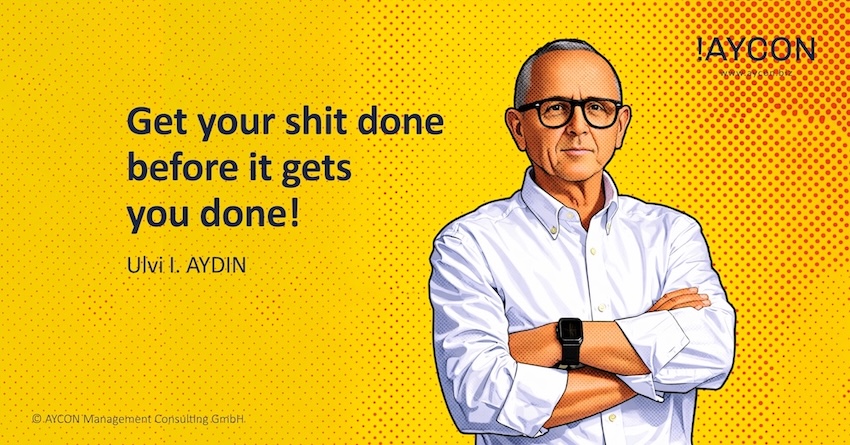
ICH bin verantwortlich. Zuallererst ICH!Das Subsidiaritätsprinzip als grundlegender Bestandteil vieler moderner Gesellschaftsordnungen sieht vor, dass Aufgaben und Problemstellungen stets von der kleinsten möglichen Einheit bewältigt werden. Von mir, von Dir!Übergeordnete Instanzen greifen nur dann subsidiär ein, wenn es unbedingt erforderlich ist.Erst dann!Das Adjektiv subsidiär bedeutet „unterstützend“ oder „behelfsmäßig“.In Unternehmen bedeutet das nichts anderes als auch in der Gesellschaft. Habe ICH alle getan, um mein Ziel zu erreichen, mein "Ding" zu machen? Wenn ich das mit "Ja!" beantworten kann - erst dann - kann ich - darf ich - Unterstützung einfordern.Verantwortung! www.aycon.biz
*
Minuten

Das Subsidiaritätsprinzip als grundlegender Bestandteil vieler moderner Gesellschaftsordnungen sieht vor, dass Aufgaben und Problemstellungen stets von der kleinsten möglichen Einheit bewältigt werden. Von mir, von Dir!
Übergeordnete Instanzen greifen nur dann subsidiär ein, wenn es unbedingt erforderlich ist.
Erst dann!
Das Adjektiv subsidiär bedeutet „unterstützend“ oder „behelfsmäßig“.
In Unternehmen bedeutet das nichts anderes als auch in der Gesellschaft.
Habe ICH alle getan, um mein Ziel zu erreichen, mein "Ding" zu machen?
Wenn ich das mit "Ja!" beantworten kann - erst dann - kann ich - darf ich - Unterstützung einfordern. :devider:
Inspiration Is Not AspirationWe often use inspiration and aspiration as if they meant the same thing.They don’t.Inspiration comes from the outside.A person. An idea. A story. A success. A failure.Something touches you, challenges you, wakes you up.Aspiration comes from within.It is the picture of who you want to become.The standard you set for yourself.The level you are no longer willing to stay below.Inspiration can give you energy.Aspiration gives you direction and drive.You can be inspired by great leaders, athletes, entrepreneurs, or people who have overcome extraordinary challenges.And you can be driven by your own aspiration — by the fire inside you to achieve more, become better, and make a difference.But neither inspiration nor aspiration defines you.Your actions do.Because ultimately, who you are and what you stand for is not determined by what inspires you or what you aspire to become.It is determined by what you actually do.Your decisions.Your standards.Your discipline.Your actions — especially when nobody is watching.You may be inspired from the outside.You may be driven by aspiration from within.But in the end:You are what you do.There is a quote often attributed to Carl Jung that captures this perfectly:“You are what you do, not what you say you’ll do.”That is the point. Inspiration may ignite you. Aspiration may drive you. But ultimately, your actions reveal who you are and what you stand for.
TURN THE TIDE
There are moments when things are not going your way.
You are behind.
The pressure is rising.
The clock is running.
That is exactly when you turn the tide.
Not by waiting.
Not by hoping.
Not by making excuses.
You turn it through energy, intensity, discipline, and the absolute will to win.
Be aggressive about your goals.
Be relentless in your execution.
Fall in love with making things happen — not with explaining why they didn't.
Fight until the last second.
And if necessary, beyond it.
Because as long as you are still fighting, the outcome is not decided.
Momentum can change.
A game can change.
A business can change.
A life can change.
You can achieve more than you think — if you are willing to give more than you thought possible.
Never surrender the outcome too early.
TURN THE TIDE.
*
Minuten
Turn the tide!
As you are still fighting, the outcome is not decided.
Strength Is a Choice
9 Japanese-Inspired Principles for Leadership and Life
I have always been fascinated by Japan.
I have had the privilege of spending time there, and every visit has left an impression on me. Japan is a country of extraordinary contrasts: tradition and innovation, discipline and beauty, silence and intensity, humility and ambition.
What inspires me most is the attitude toward discipline, responsibility, respect, resilience and self-control.
The following principles are inspired by Japanese wisdom and philosophy. I do not see them as romantic quotations to put on a wall. I see them as principles for life — and especially as principles for leadership.
Because leadership is not primarily about position.
Leadership is about character.
And character becomes visible when things become difficult.
I believe that managers and leaders who truly internalize these principles will not only become better leaders. They will become stronger human beings. And in my experience, people who live by principles like these dramatically increase their chances of succeeding — in business and in life.
1. Nobody is coming to save you.
Your stability is your responsibility.
This may sound brutal. But accepting it is incredibly liberating.
Managers sometimes wait for circumstances to improve. For headquarters to solve the problem. For the market to recover. For the organization to provide more resources. For somebody else to make the difficult decision.
Strong leaders don't wait.
They ask:
What can I do? What can I influence? What is my responsibility?
The moment you take ownership, you regain control.
2. If you cannot control yourself, you cannot lead others.
Anger is real. Frustration is real. Fear is real.
But emotions should provide information — they should not take command.
Leadership means remaining capable of acting rationally when everyone around you becomes emotional.
Anyone can appear strong when everything is going well.
Real strength is self-control under pressure.
If you want people to trust you in a crisis, learn to control yourself first.
3. The world will not slow down for you.
Markets don't wait.
Customers don't wait.
Competitors certainly don't wait.
The world doesn't care whether your organization is ready.
That sounds harsh, but managers need to understand it.
You cannot always eliminate chaos. You cannot always reduce complexity. You cannot always wait until you have 100 percent of the information.
Sometimes leadership means creating order while moving through chaos.
Adapt. Decide. Move.
4. Not everything deserves a reaction.
This is one of the most underestimated leadership skills.
You don't have to answer every criticism.
You don't have to fight every battle.
You don't have to respond to every provocation.
Sometimes the strongest reaction is no reaction at all.
Experienced leaders learn to distinguish between what is merely noise and what really matters.
Your attention is one of your most valuable resources.
Spend it wisely.
5. Being tired does not make you special.
Everybody carries a burden.
Everybody has difficult days.
Everybody experiences pressure, disappointment and exhaustion.
The question is not whether you carry a load.
The question is:
How do you carry it?
Leadership doesn't mean pretending that you never struggle. It means refusing to turn your struggle into an excuse for lowering your standards.
You may be tired.
You may be frustrated.
You may have taken a hit.
But:
Never go below your standard.
6. Trust takes years to build — and seconds to destroy.
Competence matters.
Performance matters.
Results matter.
But without trust, leadership eventually collapses.
Your people watch whether your words and your actions match. Customers notice whether you keep promises. Colleagues remember whether you stood by them when things became uncomfortable.
Reputation is built slowly.
Character is demonstrated daily.
And trust, once broken, leaves a scar.
Protect it.
7. You cannot be liked by everyone.
This is particularly important for managers.
If your goal is to be liked by everyone, sooner or later you will avoid a necessary decision.
Leadership is not a popularity contest.
Sometimes you must say no.
Sometimes you must demand more.
Sometimes you must challenge people.
Sometimes you must make a decision that is unpopular today because you know it is necessary for tomorrow.
Do not confuse approval with respect.
The strongest leaders don't ask:
Will people like me for this?
They ask:
Is it right? Is it necessary? Can I stand behind it?
8. Your pain does not give you the right to hurt others.
Pressure explains behavior.
It does not automatically excuse it.
The same applies to disappointment, frustration and personal problems.
Managers have power. And with power comes responsibility.
If you are under pressure, don't pass that pressure blindly down the organization.
If you have been treated badly, don't make treating others badly part of your leadership style.
Strong people break negative cycles.
Pain may explain behavior. Character determines what you do next.
9. Character is what remains when excuses disappear.
For me, this is the essence of all these principles.
Leadership is easy to talk about.
Character is harder.
Character means taking responsibility when blaming someone else would be easier.
Character means keeping your word when breaking it would be convenient.
Character means staying calm when you could explode.
Character means making a difficult decision when avoiding it would be more comfortable.
Character means standing up again after being knocked down.
And character means doing the right thing even when nobody is watching.
Strong managers. Strong characters.
Over many years in management, consulting and interim management, I have learned one thing again and again:
Companies don't fail because PowerPoint presentations are missing.
They fail when people stop taking responsibility.
When managers start looking for excuses.
When difficult conversations are avoided.
When standards are lowered.
When popularity becomes more important than performance.
When leaders expect others to demonstrate the discipline they themselves are unwilling to show.
That is why I find these Japanese-inspired principles so powerful.
They bring leadership back to something very fundamental:
Responsibility. Discipline. Respect. Resilience. Self-control. Character.
You don't need a title to live by these principles.
But if you have a leadership title, you have an obligation to live by them.
Because people don't follow titles for long.
They follow character.
And I am convinced:
If you take these principles seriously — not only when life is easy, but especially when it becomes difficult — you will become stronger.
As a manager.
As a leader.
And as a human being.
And strength, combined with character, is one of the most powerful foundations for success in business and in life.
Stay strong. Stay disciplined. Stay true to your standards.
Ulvi I. AYDIN
ICON Management Consulting
Kobe Bryant coined the term “Mamba Mentality” — named after his nickname, “Black Mamba.”Mamba Mentality 1. Outwork Your Expectations.Don’t rely on talent, experience, or past success. Prepare better than others. Know your market, your numbers, your customers, and your competition. Excellence is built long before the results become visible.2. Fall in Love with the Process.As an entrepreneur, you cannot fully control the outcome — but you can control your effort and your standards. Sales, strategy, difficult conversations, decisions, execution: Win the day, not just the quarter.3. Seek Discomfort.The things that matter most are often uncomfortable: calling the big prospect, admitting a mistake, having a difficult leadership conversation, stopping a project, or making a decision without having all the information. Growth begins outside your comfort zone.4. Turn Failure into Data.A lost deal is feedback. A bad hire is feedback. A failed strategy is feedback. Don’t take failure personally — analyze it, learn from it, adapt, and move forward. Ask yourself: “What will I do better next time?”5. Raise the Standard. Every Day.Mamba Mentality does not mean working 20 hours a day. It means setting an exceptionally high personal standard — and refusing to let your mood, circumstances, or other people determine whether you live up to it.Be so committed to becoming better that yesterday’s version of you is no longer good enough.And perhaps the most powerful way to translate the Mamba Mentality into entrepreneurship:Don’t chase motivation. Build discipline.Don’t chase success. Build excellence.Success becomes the consequence.MAMBA MENTALITY — THE STANDARD IS THE STANDARD.
Wenn Sie auf "Alle Cookies akzeptieren" klicken, stimmen Sie der Speicherung von Cookies auf Ihrem Gerät zu, um die Navigation auf der Website zu verbessern, die Nutzung der Website zu analysieren und unsere Marketingmaßnahmen zu unterstützen. Weitere Informationen finden Sie in unserer Datenschutzrichtlinie.